Disney and MINDstyle are collaborating on a toy collection this Spring called the Mad Hatter Project, in celebration of the 60th Anniversary of their 1951 Alice in Wonderland movie. There will be toys designed by artists Gary Baseman, Ron English and Mike Shinoda. The latter, who is the rapper and songwriter for the rock band Linkin Park, has designed the below toy, Alice connected to the White Rabbit wearing gas masks. It was sculpted by Dave Cortes from Inu Art Studio.
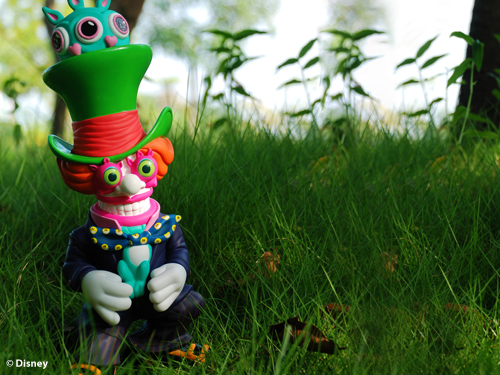
And here’s the Mad Hatter by Ron English. I assume these will be released as toys this year some time (I think we all know some kids and adults who would play with them,) but no word yet on the release date of the Mad Hatter Project.
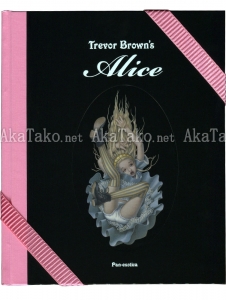
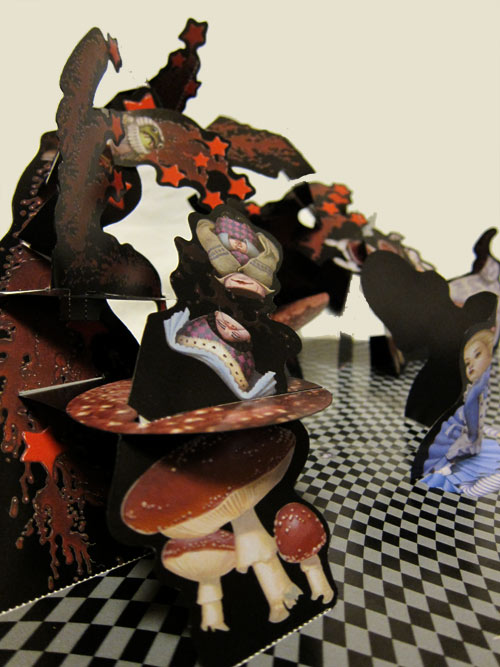
Trevor Brown’s Trevor Brown’s Alice originally came out during 2010’s March Hare Madness, and is being released again in a fancy $78 Special Edition. It appears to be a book with lots of pictures but no conversations (so, a 50% rating on the Alice Scale of Good Bookness.) Brown is a British artist who has gone native in Japan. According to Wikipedia, his “work explores paraphilias, such as pedophilia, BDSM, and other fetish themes,” so be fair-warned. He posted a version on his blog called “diy [do it yourself] pop-up kit,” which is the Special Edition hacked to pieces by the artist: “i kinda suspect everyone who’s buying the special edition alice book will consider it too precious to cut up – so, in the interests of science, i attacked my copy with scissors, to see if it is actually possible to construct the pop-up thingy.”
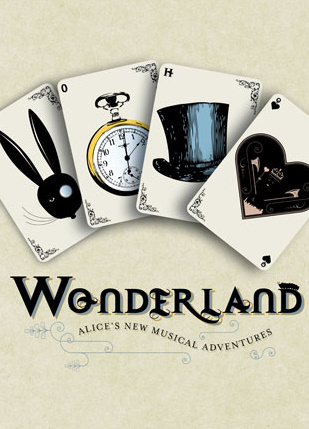
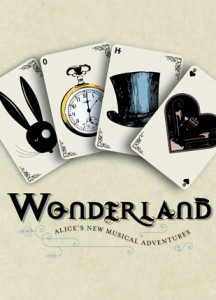
Art by John Turner of Creative Goods Design & Supply, for Wonderland, in a New York Times special feature “Adventures in Communicating a New Alice”
Art by John Turner of Creative Goods Design & Supply, for Wonderland, in a New York Times special feature "Adventures in Communicating a New Alice"
The reviews have been coming in all weekend for Frank Wildhorn’s Wonderland: A New Broadway Musical (the musical formerly known as Wonderland: A New Musical and Wonderland: A New Musical Adventure.) Wonderland’s website quotes the New York Times: “INSPIRATIONAL, FANCIFUL & GROOVY.” The Times’ review by Charles Isherwood was actually a bit more nuanced, but I suppose “…the desire to create a traditional narrative arc from the unruly dreamscape of Carroll’s original results in a convoluted story line pitting the good guys against the bad…” doesn’t fit on a marquee. Neither would “‘Wonderland’ transforms Alice’s surreal wanderings into a contemporary parable about reconnecting with your inner child and other watery truisms of the self-help industrial complex.” Kudos to Isherwood for pointing out that Alice’s “increasing exasperation to find her way home” is more Oz’s Dorothy than Alice: “a preoccupation that didn’t seem particularly urgent to the polite, spirited youngster in Carroll’s original.”
However, Adam Feldman’s proper panning for TimeOut New York was a spectacular parody of the Jabberwocky. It’s so good, I can’t resist posting it here in full:
’Tis Wildhorn, and the hapless cast
Does direly gambol on the stage.
All flimsy is the plot half-assed,
Not right for any age.
Beware of Wonderland, I warn!
The jokes that cloy, the scenes that flop!
Beware the humdrum words and scorn
The spurious, bland rock-pop!
The book’s a torpid bore in which
A newly single mom (Dacal)
Gets tested, see, by a journey she
Begins with quite a fall.
This modern Alice lands (ker-splat!)
In Wonderland, and banters some
With rabbit, caterpillar, cat
(In order: twee, dull, dumb).
She also meets a huffish Queen
Of Hearts (well-costumed Mason), and
A lady Hatter (Shindle, keen)
Who wishes to command.
These cartoon Carroll singers screech
The busy Wildhorn-Murphy score,
Which oft suggests a loud, high reach
At songs you’ve heard before.
A White Knight (Ritchie) does enact
A boy-band number that’s a lark—
But then comes the worst second act
Since poor Turn Off the Dark.
Act Two: Boo! Boo! And through and through
This Wonderland’s both slick and slack.
Dacal et al. can only do
So much to save the wrack.
And why has Wonderland been made?
Answer me that, director Boyd!
From captious gays to children dazed:
By all it’s unenjoyed.
’Tis Wildhorn, and the hapless cast
Does direly gambol on the stage.
All flimsy is the plot half-assed,
Not right for any age.
Thank you, Mr Feldman. If the LCSNA gave out an annual award for Jabberwocky parody (and we should, dash it all!) this would be a heavy favorite.
I’d also like to take this moment to mention that the actor playing the R&B-singing Caterpillar has an amazing name: E. Clayton Cornelious.
Literary historian discovers Lewis Carroll sequel, ‘Alice in Sunderland’
An academic at the University of Lancaster has uncovered a previously unheard of follow-up to Lewis Carroll’s acclaimed Alice series of children’s novels, this time set in the North East of England.
‘Alice in Sunderland is very much like the original novels,’ said Professor Terry Eagleton. ‘It might be grittier and racier, but it contains the same trademark cast of unbelievable characters performing inexplicably bizarre pastimes. I don’t think I’d be spoiling the ending for the readers to say that the things they will witness in these pages could only have happened in a dream.’
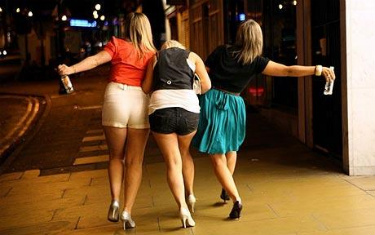
As with Carroll’s first novel, ‘Alice’s Adventures in Wonderland’, the action begins with the young heroine lazing by a river one summer afternoon. ‘Only this time Alice is a teenager and she’s spread-eagled on a bench beside the River Wear, her soporific state explained by the two dozen empty bottles of WKD and vodka whose DRINK ME labels she had no choice but to obey.’ […]
The article ends with Professor Eagleton “continuing his search for the rumoured sequel to Alice Through the Looking Glass describing a hen weekend in Gateshead.”
If your English geography is hazy, Sunderland is a small coastal city within Tyne and Wear in North East England, and the NewsBiscuit article should give you a taste of some of the local color. However, it’s not without its real Carroll connections, and NewsBiscuit is not the first to make the joke. This is a paragraph from the Wikipedia article on Sunderland:
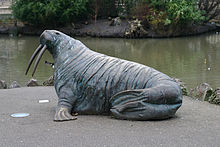
The Walrus in Mowbray Park, Sunderland -Wikipedia
Lewis Carroll was a frequent visitor to the area. He wrote most of Jabberwocky at Whitburn as well as “The Walrus and the Carpenter”. Some parts of the area are also widely believed to be the inspiration for his Alice in Wonderland stories, such as Hylton Castle and Backhouse Park. There is a statue to Carroll in Whitburn library. Lewis Carroll was also a visitor to the Rectory of Holy Trinity Church, Southwick; then a township independent of Sunderland. Carroll’s connection with Sunderland, and the area’s history, is documented in Bryan Talbot’s 2007 graphic novel Alice in Sunderland. More recently, Sunderland-born Terry Deary, writer of the series of Horrible Histories books, has achieved fame and success, and many others such as thriller writer Sheila Quigley, are following his lead.
Bryan Talbot’s Alice in Sunderland is on amazon.com here. Wikipedia’s sited reference for the claim that Carroll wrote “The Walrus and the Carpenter” at Sunderland is the website englandsnortheast.co.uk, at which I found written:
On the coast to the north of Sunderland towards South Shields is the village of Whitburn and the nearby Whitburn Sands, where Lewis Carroll is said to have written the eighteen verse poem called the `Walrus and the Carpenter’.
The Walrus and the Carpenter
Walked on a mile or so,
And then they rested on a rock
Conveniently low:
And all the little oysters stood
And waited in a row.
“The time has come;” the walrus said
“To talk of many things:
Of shoes and ships and sealing wax
Of cabbages and kings
And why the sea is boiling hot
And whether pigs have wings.”
The Sunderland and Shields area does seem a likely setting for the poem as in Carroll’s time Sunderland was a great shipbuilding port employing many carpenters. Boiling hot sea could be a reference to the steam-boat colliers in the area and a stuffed walrus in a Sunderland museum may have provided further inspiration. It is known that during his regular visits to Whitburn where he had a number of relatives, Lewis Carroll and company entertained themselves with evenings composing rhyme and song. Carroll’s nephew, Stuart Dodgson Collingwood, informs us that all but the first verse of the `Jabberwocky’ poem were written by Lewis Carroll at Whitburn. The first verse was written at Croft on Tees, near Darlington, where Carroll lived as a boy.
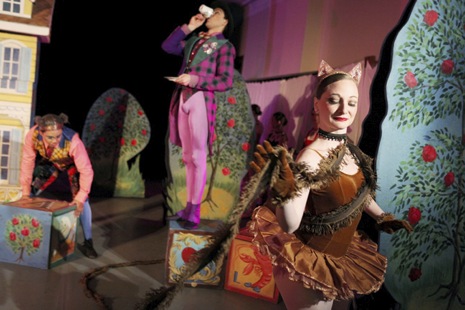
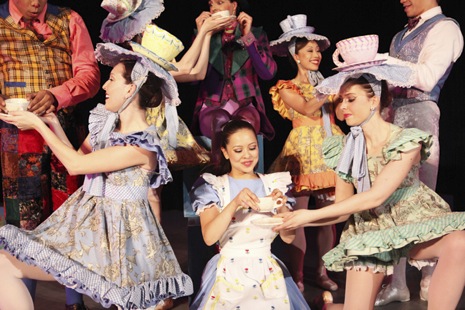
New York Theatre Ballet’s Alice-in-Wonderland Follies, photographed by the New Yorker’s Julieta Cervantes
New York Theatre Ballet's Alice-in-Wonderland Follies, photographed by the New Yorker's Julieta Cervantes
You might have noticed the above photo in the The New Yorker Magazine, April 11th, as the large image starting the Goings On About Town section. The picture was taken by Julieta Cervantes, a shot from New York Theatre Ballet’s Alice-in-Wonderland Follies, which ran April 8-9 at Florence Gould Hall. The New Yorker’s listing included a short review on pg. 11 which mentioned the recent plague of Alice ballets:
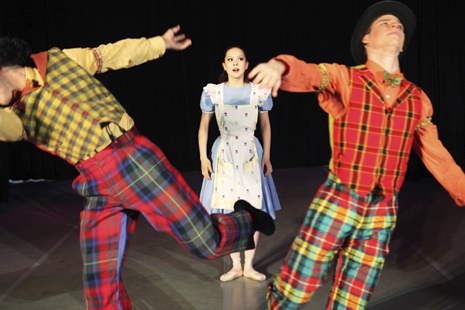
Alice is all the rage these days; just last month, both the Royal Ballet in London and the Royal Winnipeg Ballet put on major new productions. New York Theatre Ballet’s staging may not be the most lavish or the most recent (it was created in 2001), but it is not without its charms. Conceived as a ballet for children, it tells the story in a vaudeville style, with a touch of soft-shoe, a soupçon of burlesque, and a just smattering of dancing on pointe—by Alice, of course. The production is witty, clever, and blessedly brief. Gillian Bradshaw-Smith’s set designs were inspired by New York’s Palace Theatre, circa 1913, and the costumes, by Sylvia Nolan (Metropolitan Opera), are imaginative and lovely.
What New Yorker Magazine would be complete without the word ‘soupçon?’ Their blog Photo Booth includes four more of Cervantes’ lovely photos from the Follies, including these two:
New York Theatre Ballet's Alice-in-Wonderland Follies, photographed by the New Yorker's Julieta Cervantes
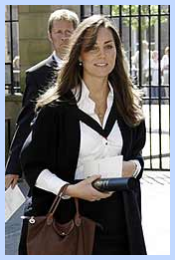
Any 6-year-old girl obsessed with Disney Princess merchandise will tell you that Alice was not one of the princesses (‘princi’?). However, it turns out a real princess seems to have been interested in Alice. At the center of the media spotlight right now is Prince William’s royal fiancée Kate Middleton, to be wed in a few short weeks, and guess what? She did her thesis on Lewis Carroll. The Daily Kate, a blog about a breadth and depth of topics as long as that topic is related to Kate Middleton, posted in June 2009 “Kate’s Lewis Carroll Dissertation Revealed.”
Posters on the internet have been circulating links to the title of Kate Middleton’s university dissertation in recent days. The topic of Kate Middleton’s project should shock no one who knows of her interest in art history and photography: it was a study of the photographic representations of childhood created by Lewis Carroll, author of the famous Alice in Wonderland books.
The website of the School of Art History at the University of St. Andrews lists an honors dissertation by Catherine Middleton, titled “‘Angels from Heaven’: Lewis Carroll’s Photographic Interpretation of Childhood.” Kate completed the paper as a part of her master’s program in art history at the university.
The dissertation topic fits well with what we’ve learned about Kate’s interest in photography over the years. Her work with her parents’ Party Pieces company includes photographing stock for the company’s catalogue and website. She also helped to host a photography exhibition of Alastair Morrison’s work to benefit UNICEF while still living in London; both Prince William and Laura Lopes, daughter of The Duchess of Cornwall, were attendees at that function.
Kate’s interest in art and photography, I hope, will bode well for her future patronage of and work with the heritage of British arts should she and William marry.
I don’t believe the text of the dissertation is out in public, which is well and good. (It’s listed on the St. Andrew’s website here.) Her thesis topic has also been mentioned recently in a Newsweek and Daily Beast article called “Citizen Kate,” if you want to read more about her. If you’re apathetic to tabloid subjects, this may seem more or less irrelevant to anything, but it is nice that the likely future Queen has good taste.
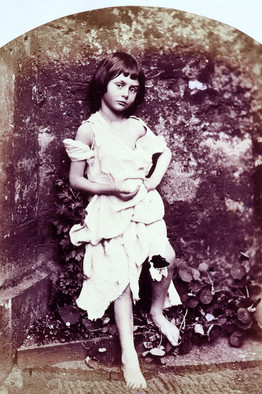
Simon Winchester, author of the excellent book The Professor and the Madman: A Tale of Murder, Insanity, and the Making of the Oxford English Dictionary, is back with a book about Lewis Carroll and the Liddell family called The Alice Behind Wonderland. The new book uses Carroll’s famous 1958 photograph of Alice as a beggar-girl as a launching point for the discussion. Former director of New York’s Morgan Museum and Library, Charles E. Piece, Jr., reviewed it in the Wall Street Journal a few days ago:
To my surprise, Mr. Winchester does not appear much interested in the influence that Alice Liddell might have had on Dodgson’s creation of the heroine of “Alice’s Adventures in Wonderland” and, six years later, “Through the Looking-Glass.” He simply relates the well-known story of how Dodgson took the Liddell girls on a picnic on July 4, 1862, during which he told them the tale of a little girl who had fallen down a rabbit hole. Alice, captivated by the tale, made Dodgson promise to write the story down and give it to her as a gift. In November 1864, he fulfilled that promise.
Mr. Winchester instead focuses on the odd estrangement between the Liddell family and Dodgson in the late 1860s, a breach that has remained largely unexplained. The most dramatic fact is that Dodgson and Liddell never saw each other again after he took the 18-year-old’s photograph in 1870.
The rest of that review is here. Simon Winchester’s The Alice Behind Wonderland was released March 17th with a hardcover price of $16.95.
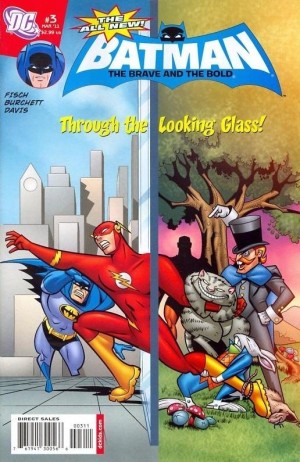
Here’s the cover for Issue #3 of the new comic series The All-New Batman: The Brave and the Bold, which was launched after the success of the Cartoon Network show Batman: The Brave and the Bold. Bob Kass writes to us: “The cover shows the Alice in Wonderland characters but the story has the Looking Glass characters. In the story, the Mirror Master, who is a classic Flash villain, sends Batman and the Flash to the Looking Glass World with the help of Mad Hatter. The story includes the White Knight, the Tweedles, Jabbewock, Humpty Dumpty, etc. There is a clever touch where the Flash’s costume insignia reverses in the Looking Glass world.”
Johanna Draper Carlson at Comics Worth Reading is happy that this issue “take[s] on some of the whimsy and charm that make its cartoon counterpart so much fun to watch.”
Issue #3, for example, takes the trendy inspiration of Alice in Wonderland to remind us of the Batman villain The Mad Hatter, who’s mind-controlling the original Flash because “he’s one of the few heroes with the good taste to wear a hat.” That kind of logic, internally consistent to the characters but ridiculously silly to the reader, adds to the enjoyment of this comic.
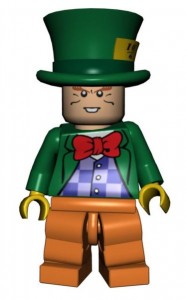
"The Mad Hatter as he appears in Lego Batman: The Videogame." -Wikipedia
Batman’s most famous enemy The Joker has been identified with Carroll’s character before (recently in The Joker’s Asylum II, June 16th, 2010.) But apparently The Mad Hatter is himself also a Batman villain, originally appearing in Batman #49 in October 1948 (according to the Wikipedia.) “Like other Batman villains, the Mad Hatter has become a darker character over the years. The Mad Hatter is depicted as a scientist who invents and uses technological mind-controlling devices to influence and manipulate the minds of his victims, believing that ‘the mind is the weakest part of a person’. He is well-known for sporting a green-coloured hat which is usually slightly over-sized as it houses his mobile mind-manipulating devices.” So that’s why the Hatter wears a big hat!


 Disney and MINDstyle are collaborating on a toy collection this Spring called the Mad Hatter Project, in celebration of the 60th Anniversary of their 1951 Alice in Wonderland movie. There will be toys designed by artists Gary Baseman, Ron English and Mike Shinoda. The latter, who is the rapper and songwriter for the rock band Linkin Park, has designed the below toy, Alice connected to the White Rabbit wearing gas masks. It was sculpted by Dave Cortes from Inu Art Studio.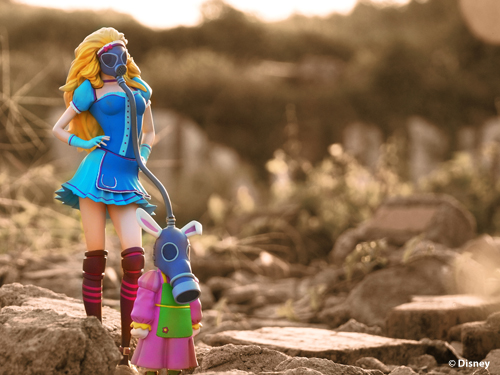
Literary historian discovers Lewis Carroll sequel, ‘Alice in Sunderland’
To my surprise, Mr. Winchester does not appear much interested in the influence that Alice Liddell might have had on Dodgson’s creation of the heroine of “Alice’s Adventures in Wonderland” and, six years later, “Through the Looking-Glass.” He simply relates the well-known story of how Dodgson took the Liddell girls on a picnic on July 4, 1862, during which he told them the tale of a little girl who had fallen down a rabbit hole. Alice, captivated by the tale, made Dodgson promise to write the story down and give it to her as a gift. In November 1864, he fulfilled that promise.