Mr. Burstein points out that today is 10/10/10 – and 101010 in binary is 42!
(42, besides being the ultimate answer to the ultimate question of life, the universe and everything, is also a number that Lewis Carroll hid throughout his books. Most famously, the King of Hearts’ Rule Forty-two is All persons more than a mile high to leave the court.)
We are big fans of Alicenations, one of several blogs of the Lewis Carroll Society of Brazil managed by Adriana Peliano. The site regularly features original and experimental music, video, and illustrations created by Adriana, together with her husband Paulo Beto, and inspired by the Alice books.
Here’s a recent creation which began life as a damaged Disney LP:
Many years ago I found a Disney Alice Record completely warped. I suddenly began to play with its stutter sounds, noises, voices and echoes, creating and recording a musical puzzle. The result is a funny game of words, a collage with dislocated meanings. My actual husband, Paulo Beto, boyfriend at that time, who is an amazing electronic music composer, recreated the material, remixing the jumping sounds.
The video below (a work in progress) makes use of some of the resulting music. Visit Alicenations for further description of the project, and the opportunity to download mp3s.
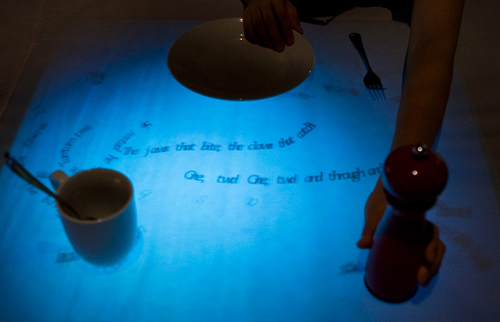
Thanks to the blog Moving Poems: The Best Video Poetry on the Web for rediscovering this Vimeo video of Hye Yeon Nam’s installation Dinner Party. I assume the video was taken at the Eyebeam exhibition in New York, 2008, and according to her website, Dinner Partywas last sponsored in July 2010 by the not-at-all-Kafka-esque-sounding Ministry of Knowledge Economy and Korean Institute of Design Promotion. She is a Ph.D. candidate at the Georgia Institute of Technology.
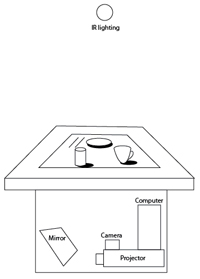
Dinner party provides a space where people meet and interact with Lewis Carroll’s poem, Jabberwocky, inspired creatures hiding in the shadows.
At first glance, the single chair and place set for one, seemingly provides a solitary dinner; rather the interaction offers a communication between oneself and the imaginary creatures. Initially gathered under the shadow cast by the plate, disturbed creatures will nervously scatter attempting to go around any other shadow cast on the table. A period of quiet status will encourage the creatures to reveal themselves.
Collaborate with Zach Lieberman and Jeremy Rotsztain
Developed with support from Eyebeam interactivos 08′
If you’re a fan of Lewis Carroll, Alice, the Snark, and you’re anywhere near the NYC area, you should check out the Eventspage of the LCSNA’s web site to see the full agenda for our fall meeting, to be held in Manhattan on Saturday, November 6th. The impressive roster of speakers includes noted author and critic Adam Gopnik, who will be discussing whether recent adaptations do or do not honor Lewis Carroll’s original works, as well as Carroll biographer Jenny Woolf, who is traveling over from England specifically for this event. Many of the speakers will be signing copies of their latest book(s), available in limited quantity at the meeting for a special 20% discount. There will be a three-course dinner at Josephina’s after the meeting, for the Carrollian cost of $42 per person.
In addition to the wonderful agenda posted on our site, we’ve just learned that member Mahendra Singh will also be on hand to sell and sign copies of his new edition of The Hunting of the Snark. This is a don’t miss meeting. It occurs on the weekend of the NY Marathan, however, so if you need accommodations, you should check with hotels (or local friends!) right away.
Please remember to let Secretary Clare Imholtz know if you plan to attend so that we can keep track of the headcount, as we expect a big turnout and seating is limited. You don’t need to be a member to attend our free meetings. We hope to see you there!
I’m not sure if Lewis Carroll’s books have ever been converted into video poker machines before. (Has anyone ever seen one?) But now, there’s an online video slot version called “Alice’s Wonderland” released last week at Virgin Casino. You have to be registered on that site to play (which, correct me if I’m wrong, citizens of the U.S. have to have an offshore bank account to gamble online…)
According to Betastic(“your guide to online gaming”):
No surprises in predicting that this five reel, twenty line video slot is centred around Lewis Carroll’s magical Alice In Wonderland. There are three bonuses which can all be won in the same spin: Mad Hatter’s Tea party (progressive jackpot); Rabbit Hole; Free Spins bonus with additional wild symbols.
The jackpot is starting at £10,000, with other prizes including web-cams and Alice in Wonderland DVDs. But like most looking-glass gambling experiences, I’m sure your money will get further from you the more you walk towards it.
Isabelle Melançon, creator of the new web comic Namesake, which has just launched, promises that Lewis Carroll, Alice, and many familiar fairy tale characters figure prominently in the story. From the web site:
“Namesake is the story of Emma Crewe, a woman who discovers she can visit other worlds. She finds out that these are places she already knows – fantasy and fairy lands made famous through the spoken word, literature and cinema. Her power as a Namesake forces her to act as a protagonist in these familiar stories as she figures out how to get home. But as she travels, she discovers that those controlling her story have their own selfish goals in mind – and her fate is the key to everyone’s happy ending. Join Emma, her sister Elaine and their friends as they tumble down the rabbit hole. If you like, adventure, humor, stories of friendship, fairy tales and fantasy, this is the webcomic for you.”
Click the image on this post to visit the site. Since the comic will have new content three times a week, if you like what you see, you might want to subscribe to the site’s RSS feed to make sure you see the prologue and all subsequent pages.
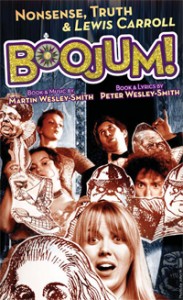
Caffeine Theatre and Chicago Opera Vanguard will be premiering Boojum! Nonsense, Truth, and Lewis Carroll on November 18th thru December 19th, 2010, at Chicago DCA’s Storefront Theater. (I understand the “Nonsense” and the “Lewis Carroll,” but will withhold judgment on the “Truth.”) Caffeine Theatre is hosting a nonsense poetry contest, the winners to be incorporated into the play! The guidelines, as posted by Emily Wong at Gapers Block:
Caffeine Theatre wants YOU — to send them your original poetry for their “Old Father William’s Frabjous and Curious Poetry Contest.” Just follow their rules:
Submissions may include any size or style of poem, as long as it is inspired in some way by the life or work of Lewis Carroll, or in some way speaks in conversation with that life or work.
Nonsense poems and poems exploring symbolic logic are especially encouraged.
Winners will be posted and podcast on Caffeine’s website, and performed at the Lewis Carroll Coffeehouse at the end of November.
Any new or previously written poem may be submitted (provided it can be republished/recorded/performed).
Submit your Lewis Carroll-inspired, nonsense poems by emailing the poems and a 3-5 sentence description of their relation to Lewis Carroll to the Caffeine Theatre Associate Artistic Director, Daniel Smith, at dan@caffeinetheatre.com. Make sure you have “Old Father William” in the subject heading! The deadline for submissions is October 31, 2010.
Meanwhile, while you’re waiting for Boojum!, Chicago’s Crown Point Community Theater is staging an adaptation of Alice in Wonderland, opening this Friday, October 8th. “It’s a very playful adaptation,” said director Liz Love according to the Post-Tribune. “The other characters are all getting ready to perform ‘Alice in Wonderland’ but they have a problem. They have no Alice. But as luck would have it there just happens to be a girl named Alice and they help her find her way into the story.”
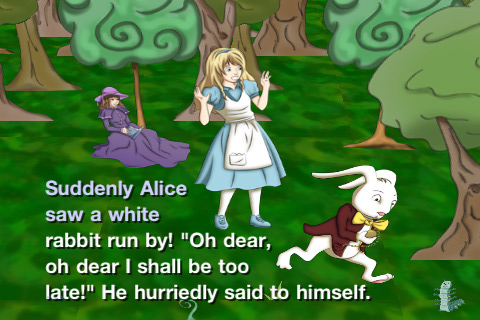
Miniville, makers of “tiny apps for tiny hands,” have re-released their Alice in Wonderland interactive storybook application for iPhone/iPod/iPad. This completely revamped version features new artwork, new audio, and new ways for children to interact with the abbreviated and adapted story.
You can download a free version that includes some advertising, or an ad-free premium version for $0.99. Even better, John Jumper, the app’s developer, has kindly offered five free copies of the premium edition to Lewis Carroll Society members. We will send the promotional code to the first five people who email us at farflungknight@gmail.com.
For those of you who are just curious to see another example of this one possible future of children’s books, John Jumper has created a demo video on YouTube.
Rebecca Mead’s article about the play Gatz, in the September 27th, 2010, issue of The New Yorker, had a nice parenthetical quip in re Alice adaptations:
[John] Collins [founder of Elevator Repair Service theatre company], who is courtly and subdued in nammer, had directed productions as an undergraduate: his first full-length show, “The Real Mary Ann,” was based on “Alice in Wonderland” and was performed in the basement of Pierson College. (“Every experimental director has to go through an “Alice in Wonderland” thing, and John was very lucky to have gotten his out very early,” James Hannaham, a novelist and journalist who was an early member of the company, says.)
Another talented young thespian currently scratching that itch is Yale University’s Oren Stevens, class of 2011. As reported in the Yale Daily News last week:
Starting October 7 to 9, Stevens — a longtime participant in the Yale Dramat with more than a dozen credits under his belt — will be seeing his piece, “Phantomwise,” be produced on the stage of the legendary Yale Repertory Theatre. The play is an official Dramat production and is the second student-written play to get the Dramat’s support in recent memory, after George’s “Commandments” was produced last spring.
“Phantomwise” follows the story of Alice Liddell, the English beauty who was the inspiration for Lewis Carroll’s “Alice’s Adventures in Wonderland.” The play weaves together the true story of Liddell’s life with the children’s classic tale, traveling between fantasy and reality.
If you know of (or attend) Carroll-themed performances: let us know!
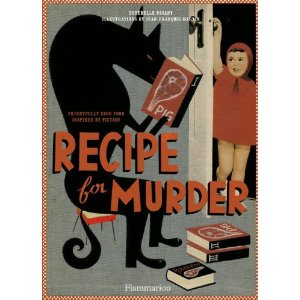
Wondering what to serve at your Halloween dinner party? How about Patrick Bateman’s roast beef with truffled mashed potatoes, followed by Snow White’s stepmother’s caramel apples? Recipe for Murder: Frighfully Good Food Inspired by Fiction by culinary journalist Estérelle Payany appears to be full of good ideas for macabre entertaining.
Similar in concept to Alice Eats Wonderland published earlier this year, this is a cookbook for those who like their recipes fully contextualized:
Thirty-two great hero-villains of literature lure the reader into the kitchen to sample their signature recipes. Estérelle Payany shares to-die-for recipes inspired by scoundrels from popular literature. Each chapter opens with an excerpt from the original story and quirky illustrations by Jean-François Martin featuring the criminal and his recipe.
More sneak-peeks of the fabulous illustrations can be viewed on the blog Brain Pickings, though unfortunately there is no glimpse of the Queen of Hearts who, we are told, has contributed her recipe for treacle tarts.
Recipe for Murder is published by Flammarion and is selling on Amazon for $17.96 (hardback).



 Caffeine Theatre wants YOU — to send them your original poetry for their “Old Father William’s Frabjous and Curious Poetry Contest.” Just follow their rules: