In 1957, a popular dramatized LP version of Alice’s Adventure’s in Wonderland was released, narrated and sung by Cyril Ritchard. It’s still widely available, even on iTunes here. The music, which many children of that generation heard so many times, was written by light classical American composer Alec Wilder – (He also wrote television operas, like Miss Chicken Little [1953] for CBS, and was friends with Frank Sinatra and Tony Bennett.) A piano reduction of this score, with song versions of just about every poem in AAIW, has been in print from Tro Ludlow Music since 1986. However, the original instrumental score, for woodwind quintet plus percussion, was lost.
The Blog of the LCSNA
Burbles
The Blog of the LCSNA
New York Times makes “Through the Looking Glass” reference in their headline about Bergdorf Goodman’s 5th Avenue Alice-themed Window Display
Hey, kid-
Wouldn’t you like to be on Broadway?
And wear some Bergdorf Goodman clothes?
Red alligator shoes, a golden anklet,
And seventeen dozen nylon hose,
Hey, kid!

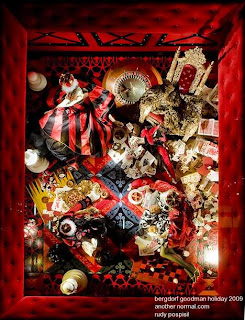
Bergdorf Goodman’s windows beckon with a swanky sparkle. “Alice in Wonderland” is the loose inspiration, and some fancy clothes play a role, but exquisite handicraft is the star of the show.
The shine comes from a vision in mirrors: A silver lobster plays a silver violin, beneath fluted columns with mosaic animal heads, under a disco ball surrounded by a Venetian frame — all reflecting the street scene, and all echoing a dramatic Pamella Roland gown swooping down from above.
Elsewhere, a king and queen, in black and red, sit on a chess board playing cards and drinking tea. But the chessboard is standing on edge against the back wall of the display, so the view is of the top of the monarchs’ heads — a neat optical trick that makes it seem as if you are peering down from above rather than walking by on the sidewalk.
The true standout is a fantasia of white, built — literally and literarily — out of books. In a space covered top to bottom with whitewashed volumes, a dodo bird with feathers made out of pages hobbles near a turtle with a lamb’s head. A tea party spills out of the pages of an open tome like a tongue out of an open mouth. Delicate birds flutter out of another with origami pages. You could stare at it for an hour and only then notice the frog wearing a judicial wig.
“It’s everything you want from a window,” my friend said. “You basically want to feel like the Little Match Girl, with your nose pressed up against the glass. You want to be delivered from your drab existence in just the moment before you perish from the cold.”
Alice Miniseries on the Syfy Channel, December 6th-7th

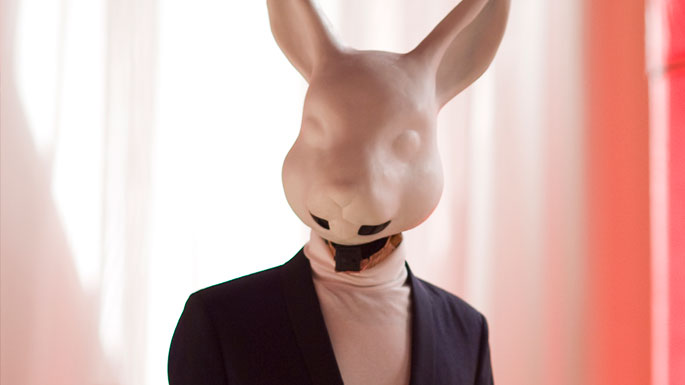
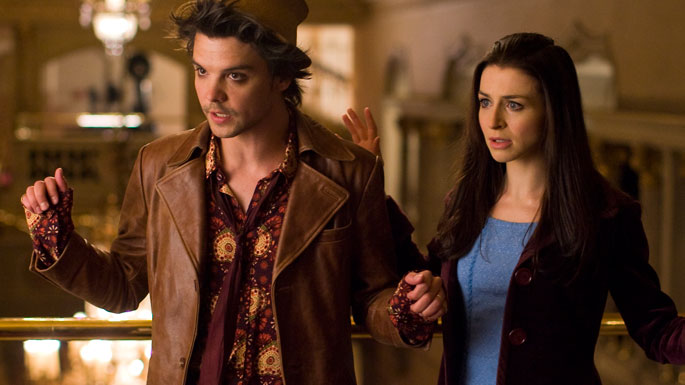
If you haven’t heard the hype, Syfy is rolling out a hot new four-hour miniseries inspired by Lewis Carroll’s Alice books, this coming Sunday and Monday evenings starting at 9pm. (Syfy used to be called the Sci Fi Channel, and this rebranding is being boycotted by the Pittsburgh Post-Gazette and Slate as an “unsupportable offense against orthography.”) This show should should be a wild take on the Alice “myth”, with Carroll listed as only one of many influences including Doctor Who and other classic genre-benders. The adult Alice (Caterina Scorsone) can do karate. You may remember Harry Dean Stanton, who plays an insurgent Caterpillar “resisting” the Queen of Hearts, as a regular from David Lynch movies and the slithery Fundamentalist Mormon prophet in Big Love. And the Dodo, also an insurgent, is played by Tim Curry, who was of course once the sweet transvestite transsexual from Transylvania. The Syfy plot sounds too complicated to recap before seeing it, involving some sort of coveted ring of power, the Gem of Wonderland, but the production and acting all sound first rate. There’s trailers and other promo material at www.syfy.com/alice, and Troy Patterson’s review at Slate (which I was just paraphrasing) is here. Patterson coined a delicious Carrollian portmanteau “maluscious” (luscious and malicious) to describe Kathy Bates’ Queen of Hearts.

Lauren Mechling on Alice: "We are all changelings."
Lauren Mechling, the author of the Dream Girl series (starring the irritatingly named Claire Voyante), has a short essay posted today about Carroll and Alice at the Wall Street Journal’s blog Speakeasy. In lieu of the high-profile Alice projects coming out, she looks at the phenomenon thru her modern Teen-Lit spectacles:
[…] Yet the weirdness for which the story is best remembered is beside the point. Trippy as the events may be, its sharpest element is the profound sense of melancholy overhanging them. “‘It was much pleasanter at home,’ thought poor Alice, ‘when one wasn’t always growing larger and smaller and being ordered about by mice and rabbits,’” wrote Carroll. Near the end of the tale, a hookah-smoking caterpillar asks her who she is. “‘I hardly know sir,’” she replies in good-mannered consternation. “At least I know who I WAS when I got up this morning, but I think I must have changed several times since then.”
In addition to going it alone, Alice is stuck dealing with a body that is betraying her every step of the way. It’s a universal—and horrifically personal—condition. I defy you to find anyone who hasn’t watched on with alarm as her body grew pimples, love handles, or, with enough years, begun to curl over and shrink. Some fuss has been made over Burton’s choice to cast a 19-year-old actress rather than a child to play Alice in his film version, but the Alice experience is not constrained to the world of children. Quite the opposite.
And when Carroll writes, “‘For it might end,’ Alice said to herself, “in my going out altogether, like a candle. I wonder what I should be like then?’” we feel the author’s frustration and sadness layered over Alice’s own. We are all changelings. And, all the more excruciating, so are our loved ones—a fact that Carroll knew all too well.
We should ask them why a raven is like a writing desk.
Swann Galleries to auction "Portrait of Emily Cecilia Harrison"
On December 8th, Swann Galleries in New York will be auctioning Dodgson’s “Portrait of Emily Cecilia Harrison,” a 6.5 by 5 inch albumen print of Emily and her doll in a comfortable-looking chair. The sale is notable, first for its seriously fancy online “3D” catalogue, and secondly for a very exciting re-telling of Mr Dodgson’s biography:
Although best known for novels “Alice’s Adventures in Wonderland” and “Through the Looking-Glass,” he also invented croquet, billiards, various forms of chess, scrabble, ways to divide certain numbers and two different form of the Arabic zero.
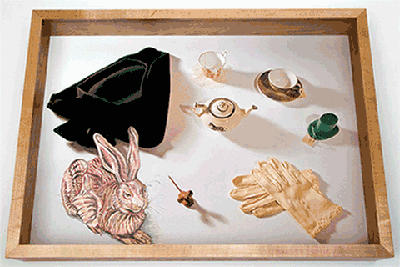
The estimated sale price is $4,000 to $6,000. Perhaps it should be higher?
Силви и Бруно: Sylvie & Bruno now in Bulgarian!
I believe this is the first time Lewis Carroll’s Sylvie & Bruno has appeared in Bulgarian, in a new translation by Rosa Grigorova. Here’s the blurb from knigagb.com:
Очарователната приказка – последното голямо произведение на Луис Карол, е триумф на човешкото въображение, каквото само човек с неговата рядка чувствителност може да създаде.
За „Силви и Бруно” литературните критици казват, че това е трудът на живота му, а книгите за Алиса са само генералната му репетиция.
Разказ за странните приключения на малки сестричка и братче в три различни места: Англия, Фейландия и Вънландия – прелестна пародия на реалния свят на Карол в Оксфорд с веселата си йерархия от ректори, заместник-ректори и ерудирани, макар и много разсеяни професори, и още десетки други, всички изобилно поръсени с типичната за Карол игра на думи, до един въвлечени в заплетени и изпълнени с напрежение приключения, пътуване във времето, несподелена любов… и гения на един от най-очарователните и изобретателни виртуози на английския език.
Poet Marianne Moore & Lewis Carroll creatively combined in an exhibition by Sue Johnson at Philadelphia’s Rosenbach Museum & Library

The Rosenbach Museum & Library’s Artist-in-Residence Sue Johnson has an original installation called Moore Adventures in Wonderland running from September 23rd, 2009, thru June 6th, 2010. The Rosenbach collection is highlighted with large archives by both Lewis Carroll and Marianne Moore, the witty American modernist poet, so Johnson’s installation sets out to explore the two writers’ connections. In her own words (quoted in last Friday’s Philadelphia Daily News):
Moore almost exclusively uses nature as her platform. She doesn’t people her poetry very often, and I felt a resonant chord with that. With Carroll, of course, it’s Alice’s adventures, but it’s Alice’s adventures with creatures that have been anthropomorphized. So I thought that there was a good conversation that could be had there between two creative people that I felt an affinity with.
Alice at 8,700 feet
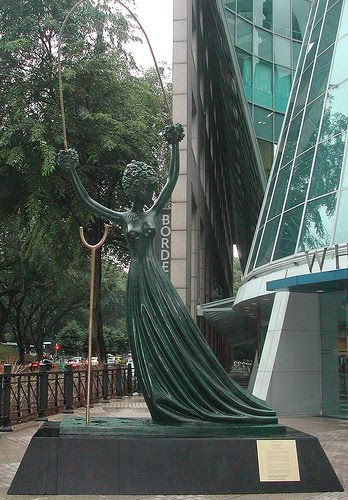
With all the coverage of the forthcoming Tim Burton movie and Syfy channel series, Alice does seem to be getting about at bit lately. However, there must be someone out there left to be surprised at finding her 8,700 feet up a mountain in the French Alps.
The ski resort of Courchevel, favored winter playground of Russian oligarchs, Saudi Arabian princes and well to-do British families, is known for extravagance. Their decision to hold a season-long exhibition of Dali sculptures, including his “Alice in Wonderland”, up and down the mountain sides is, therefore, business as usual in that surreal and expensive winter fairyland.
The video below shows the thirteen foot-tall statues of “Alice” and “Woman in Flames” being manoeuvred into place. I particularly like the part where Alice is flying between the mountains, suspended on a long cable beneath the helicopter.
Lou Bunin’s 1949 animated Alice in Wonderland showing in L.A. on Saturday
Cinefamily, a “movie lover” organization in L.A., will be showing Lou Bunin’s Alice in Wonderland at the Silent Movie Theatre, 611 N. Fairfax Avenue, Los Angeles, CA 90036. Two shows on Saturday, November 28th, at 5:00 & 7:30pm, for $12. Here’s the description & musical clip from their listing:
Alice In Wonderland (1949)
This ambitious, highly faithful late-’40s Alice adaptation took years to complete, and features an abundance of impressive, meticulous and labor-intensive stop-motion work from pioneer puppeteer Lou Bunin. After a live-action prologue showing the historical inspirations for the major characters, Alice (a decidedly adult Carol Marsh) is quickly launched into surreal realms of design and color. Remarkably, the film stays true to the original novel’s anarchic construction, and the inspiration of Victorian illustrator John Tenniel’s Alice imaginings. Bunin’s handiwork is at its peak during the musical numbers, which dunk you head-first into the film’s opium-riddled dreamworld–and in addition, live-action director Dallas Bower comes up with clever, simple solutions to the FX limitations of the day. Originally suppressed by Disney for fear of its potential upstaging of their own animated Alice, Bunin’s work comes to you here at the Cinefamily in a rare screening of a beautiful MOMA-restored 35mm print!
Dirs. Dallas Bower & Lou Bunin, 1949, 35mm, 76 min.
New Alice book illustrated by LCSNA member out now
At the LCSNA Spring Meeting in 2008, Oleg Lipchenko, artist, illustrator and LCSNA member, described the challenges of illustrating Alice’s Adventures in Wonderland anew. “It’s like illustrating “IT.” You know what “IT” means, right?”
Dear friends,
I’m glad to inform you all that a new edition of Alice with my illustrations published by Tundra Books is available in bookstores:Barnes and Noble, USAChapters.Indigo, CanadaI am grateful to all of you who purchased a copy of the Limited Edition and helped me to move ahead with my illustrations. My next my book will be published by Tundra Books in 2010. It is Humpty Dumpty And Friends. Still several copies of the Limited Edition of Alice (Studio Treasure) are available at: www.surrealice.com
Yours,
Oleg Lipchenko, artist, illustrator


The true standout is a fantasia of white, built — literally and literarily — out of books. In a space covered top to bottom with whitewashed volumes, a dodo bird with feathers made out of pages hobbles near a turtle with a lamb’s head. A tea party spills out of the pages of an open tome like a tongue out of an open mouth. Delicate birds flutter out of another with origami pages. You could stare at it for an hour and only then notice the frog wearing a judicial wig.
Although best known for novels “Alice’s Adventures in Wonderland” and “Through the Looking-Glass,” he also invented croquet, billiards, various forms of chess, scrabble, ways to divide certain numbers and two different form of the Arabic zero.