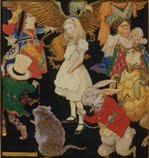

Here’s a rare opportunity to compare famous visual interpretations of Alice side by side, and a must-see for all lovers of children’s book illustration – if you live in Pennsylvania that is:
“Alice in Pictureland: Illustrations of Lewis Carroll’s Classic Tales”
Alice, the Mad Hatter, the White Rabbit and the other wonderful, fanciful figures found in Lewis Carroll’s famous books have delighted people of all ages since their first appearance in Alice in Wonderland (1865) and Through the Looking-Glass (1871). This exhibition includes work by John Tenniel, the first illustrator of Carroll’s Alice stories, as well as by subsequent noteworthy artist-interpreters, including Arthur Rackham, Peter Newell, Jessie Willcox Smith, and Barry Moser. The exhibition features over 40 objects, including original artwork, proofs, prints, and first edition books.
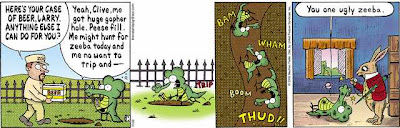
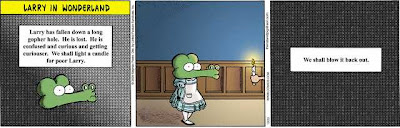
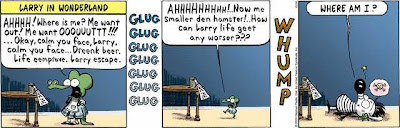
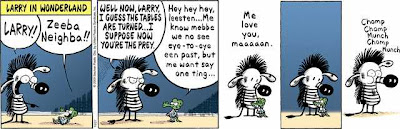
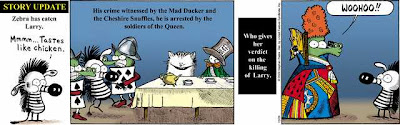
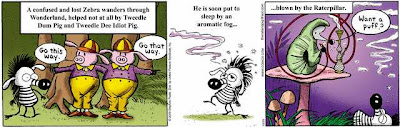
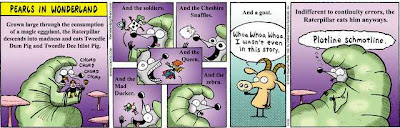
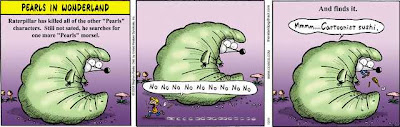
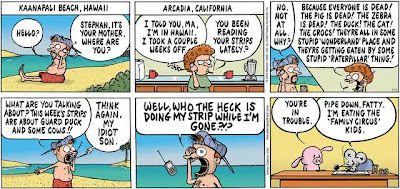
Pearls Before Swine, a nationally syndicated comic strip which runs in more than 400 papers, had an Alice in Wonderland-inspired sequence at the end of October 2009. The decade-old cartoon is written & drawn by San Franciscan Stephen Pastis. (The internet home of Pearls Before Swine is at the United Feature Syndicate website here: comics.com/pearls_before_swine, where I’ve copied the strips below from.) They reminded me of Walt Kelly’s illustrations for “Who Stole the Tarts?” using similar anthropomorphic characters from his mid-century newspaper comic Pogo. If they’re too small to read, click on the image and it will redirect you to the strip at comics.com.
An interesting twist in the scenario: instead of it being “such a curious dream”, the surreal wonderland adventures were the result of one of the other characters usurping the composition of the comic strip. Like the Red King’s dream, was the rat drawing the cartoonist or the cartoonist drawing the rat?
Twenty new cards from Blue Barnhouse called “A Weekend With Alice” re-interpret Sir John Tenniel’s classic Alice illustrations with irreverent captions. There’s also others with the same trick using Oz and other retro illustrations. Available for $5 a pop at the Blue Barnhouse online store.
There’s also four in their Drug department (not just making the obvious jokes, they’re pretty left-field. The illustration of the White Rabbit with trumpet & scroll is captioned “Somebody hold my MFA so I can light this thing.”)
Frank Wildhorn is the musical theater composer who brought the world Jekyll & Hyde and The Scarlet Pimpernel at a comparatively young age. Wonderland: Alice’s New Musical Adventure will be playing the counties for the next few months with aspirations of Broadway. The World Premier will be in Florida at the Tampa Bay Performing Arts Center on November 24th, and run thru January 3rd, 2010. It will then leap to the Alley Theater in Houston, Texas.
Here’s the blurb with a synopsis from their website:
Now, they are most definitely and exactually BACK!
In this world premiere of a new musical by lyricist Jack Murphy, book writers Jack Murphy and Gregory Boyd and acclaimed composer Frank Wildhorn, Alice is a children’s book writer in Manhattan who is suffering through a creative block, estranged from her husband and alienated from her daughter. It takes a trip to a strange-yet-familiar Wonderland for her to regain her life’s balance and again find the love and everyday magic that reside in us all – if we know how to look.
Wildhorn’s score taps into numerous pop styles, and Murphy’s lyrics provide both wit and wisdom.
Be among the first to see this exciting new production.
There must be something in the zeitgeist that there’s so many older-Alice-returning projects to hit simultaneously. (Or is this a perennial take on classic children’s literature?) What follows is a slideshow with one of the songs, ending with an advertisement: “Journey with a modern-day Alice to Wonderland and the Looking-Glass World where she must find her daughter, defeat the Queen and learn to follow her heart…”
And here’s a few more musical clips from their website:
For those of you who like your pop-classical overproduced and over-enunciated, hot tweenage British singer Faryl Smith is releasing her second album (quick on the heels of her first album Faryl, which was the fastest-selling “classical” album of all time.) Wonderland, due on November 30th, is “loosely based on Lewis Carroll’s novel”, according to this evening’s Evening Telegraph.
“[Alice’s Adventures in Wonderland] is one of my favourite books,” says the former Britain’s Got Talent contestant. “It’s so dreamy and playful.”
{video no longer available}
Keep watching after the musical clip, the second video is Miss Smith personally announcing Wonderland. It’s important to put all this in its proper cultural context, and remember that in the 2000s, hyper-sexualized images of underage girls in popular music was standard and should be judged against the backdrop of the norms of the times.
Strange creepy creatures come out of your dens, and go to the world premier of The Hunting of the Snark at the Queens International Film Festival on Saturday, November 14th, 2009. The 30-minute student film is the directorial debut of Peter Pavlakis, a Brooklynite. The synopsis sounds like the plot sticks close to the Carroll poem, and the film trailer has an actor reading verbatim one of the rhymed speeches – so, we can expect a bit of fidelity, not a psycho-sexual re-imagining of the Bellman returning to sea a decade later to confront his nightmarish inner demons (ending in a car chase).
This will be at noon tomorrow at the Frank Sinatra School of the Arts Charter Room, 35-12 35th Avenue, Queens, NY 11106.
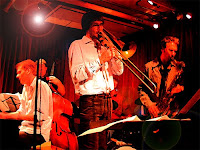
Also coming out this week with the same title, the transatlantic “cosmopolitan post-bop” group NYNDK released “The Hunting of the Snark” on the label Jazzheads. The album includes hip versions of Charles Ives, Edward Grieg, and Carl Nielsen. The titular track (which can be heard online here) begins with some snarky outgribations on trombone, but I couldn’t find any explanation for the use of the Carroll poem’s title beyond catchy inspiration.
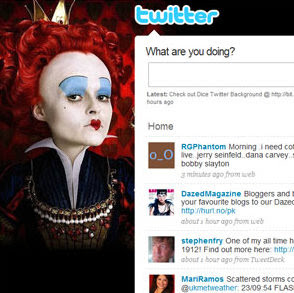
In the opening preamble for the forthcoming Fall 2009 Knight Letter, Mark Burstein says that my “first act as co-FF-editor was to create a Twitter stream at http://twitter.com/AliceAmerica as an alternate way to follow the blog…” While I’m slightly embarrassed that this was my inaugural motion, it is true that, if you use Twitter’s services, you can now follow @AliceAmerica for alerts from this blog and other notices.
If you are confused about why Twitter exists, and why the mainstream media seems so obsessed with mentioning it as often as possible, there is no reason for you to worry or change anything about your life. (I personally see the service neutrally, between the extreme loves and hates it has generated.) Twitter is basically a global text-messaging service, for posting public or private 140-character messages, and following the messages of your friends or celebrities, politicians and pundits. One of my favorite tweeters is 17th century London diarist Samuel Pepys, who recently wrote “My wife is mighty fine, and with a new fair pair of locks, which vex me, though like a foole I helped her the other night to buy them.” If you desired, you could set it up to receive @AliceAmerica’s messages on your mobile phone in hundreds of countries. I’ve also just created a twitter list of Carrollians at @AliceAmerica/carrollians – which I’ve embedded in the lefthand sidebar of this blog – to follow the various Carroll & Alice-related twitterings. Please e-mail us or comment below if you have any suggestions of more Carrollians that list should follow.
Attention Portuguese-speaking Lewis Carroll readers! The Lewis Carroll Society of Brazil has several colorful blogs and websites with a bottomless rabbithole of books, links, art, tudo Alice. Look at all of these edições Brasileiras deAlice no país das Maravilhalisted on the dizzying alicenations.blogspot.com. (The groovy cover to the left is from a 1974 edition with ilustrações by Brazilian artist Oswaldo Storni.)
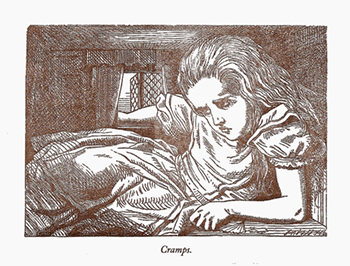
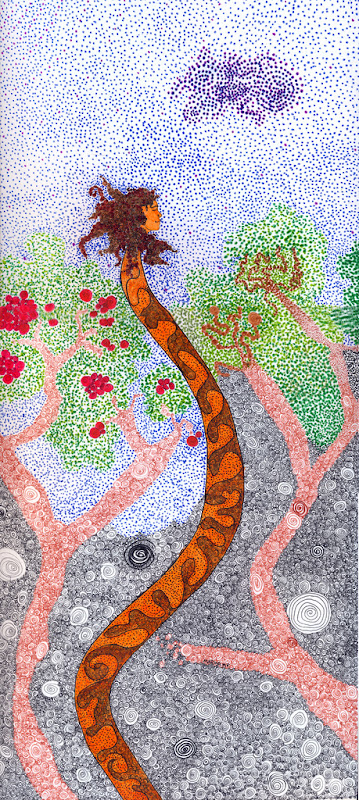
Their second blog, for “deeper research with more articles and images”, is at brasillewiscarroll.blogspot.com. This one is also expansive, and both sites have some English (always demarcated by stylish italic pink text). I’ve long been a fan of reading websites in translation using the various cyborg cyberspace interpreters at our disposal, and the Sociedade has provided an occasional easy link to do so. For instance, if you desired to read Myriam Ávila’s Alice e Macunaíma, you could feed it thru Google Translate like so. This occasionally creates interesting sentences like: “Such people, the girl significantly calls ‘obnoxious’ (meaning ‘antipodal’), are Anglophones, even though they walk ‘upside down’.” (Both websites, unfortunately, include all or most of their posts on their homepage, so they can take a long time to load on slower computers.) There is also an impressive cache of art and illustrations on these two blogs, like the large one that I’m putting at the foot of this post, which comes with the following pink italicized explanation:
Marina Peliano once was my little sister. But she ate any strange cookie and so suddenly she grew turning trapeze artist, sweet maker and art student, artist growing too. I asked her to do some drawings inspired on Alice and she followed the adventure. I found really beautiful her Alices who look like her. I remember now the letter of the writer Paulo Mendes Campos to his daughter when she was fifteen: “This book is crazy. The meaning is in you.”
Mark Godburn’s website about early dust jackets has been reinvented in blog format, at earlydustjackets.blogspot.com. He will chronicle about all manner of early dust jacket topics, “including precursors to publishers’ jackets and early 20th century jackets; also publishers’ boxes, slipcases and sheaths.” Godburn’s upcoming book is called Nineteenth Century Dust Jackets: An Illustrated History.
In his blog’s sprawling inaugural post, he prints Dodgson’s letter to his publisher Macmillan in re the “paper wrapper” for The Hunting of the Snark. Mr. Godburn says this is the earliest written reference he knows to 19th century dust jackets. “I should like the same thing done for Alice and the Looking-Glass for the future,” writes the Reverend, “–and even those on hand, which are already wrapped in plain paper, might be transferred into printed covers.” And speaking of peculiar creatures that won’t be caught in a commonplace way, here’s the skinny from Godburn on the state of Carroll dust jackets:
At least eight or ten copies of the 1876 Snark are known to survive in jacket, but no copies of Alice or Looking-Glass from the 1860s or ’70s are known to survive in either plain or printed jackets. (If a first English edition of Alice in Wonderland ever does turn up in an original publisher’s jacket, it will certainly be a $100,000 book, perhaps half a million.)
I think the creepiest clip from an Alice movie I’ve seen recently was unintentionally scary, which Jenny Woolf linked to at her blog, brought to light in re Will Brooker’s book Alice’s Adventure: Lewis Carroll in Popular Culture (2005). “He suggested looking into the Alice in Wonderland phenomenon in Japan, (where she is known as Arisu).” That’s where this animated Lego version comes in:
And what Hallowe’en could be complete without a bit of Jan Švankmajer: