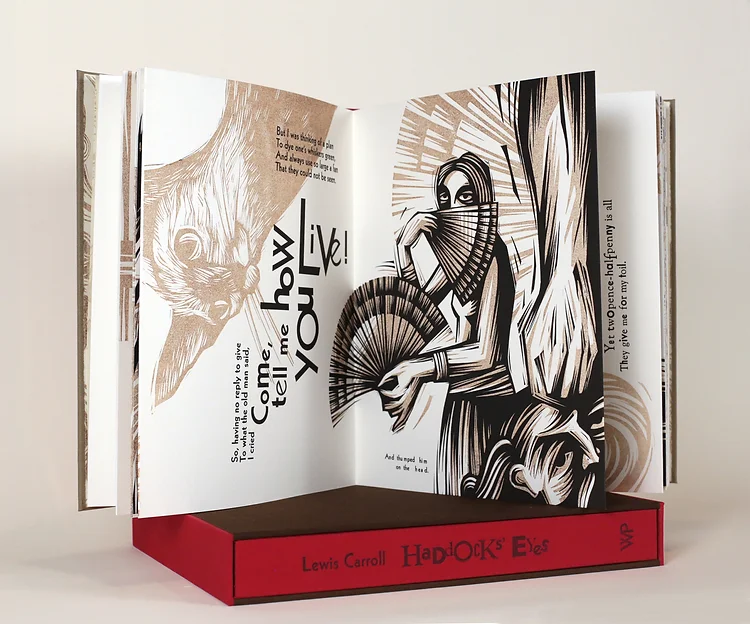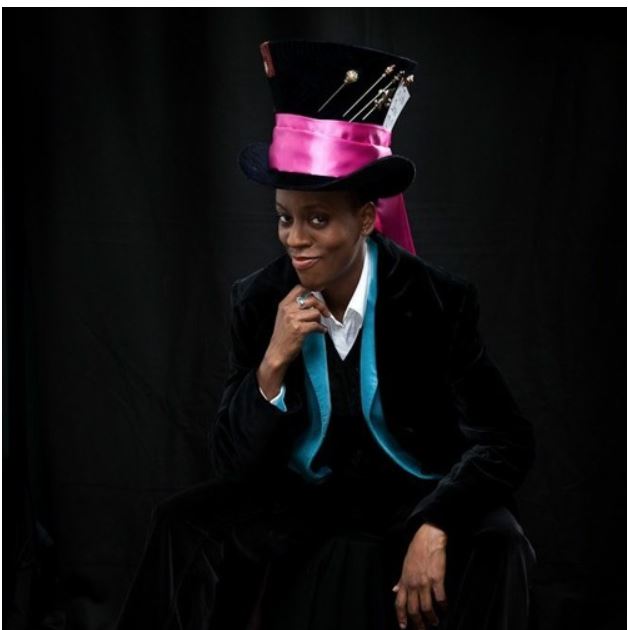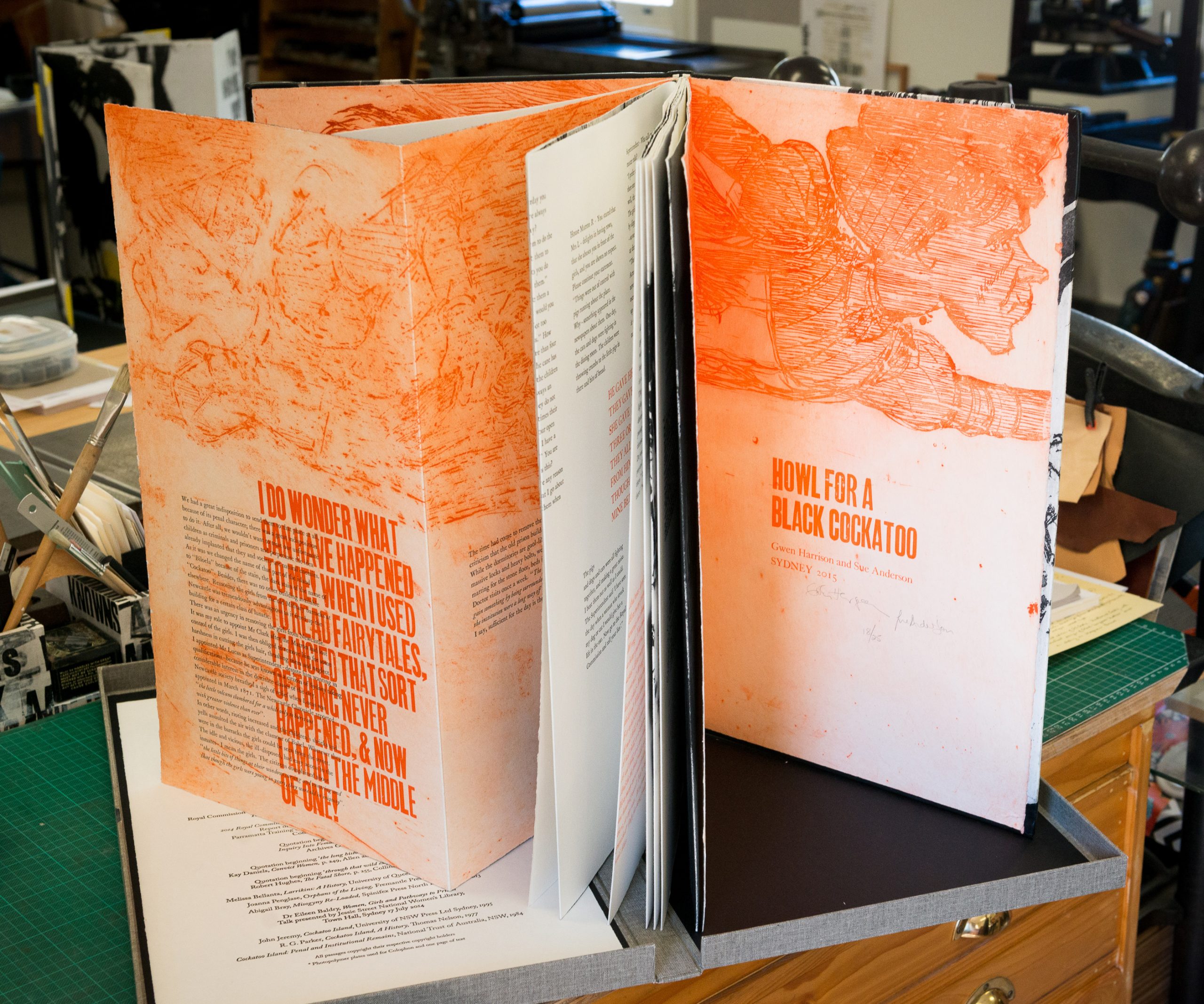

Composer Bruce Lazarus posted a link on our Facebook page about The Lewis Carroll Project, his art song cycle dedicated to the life and works of Lewis Carroll. Lazarus has drawn his libretto from both well-known and lesser-known Carroll writings, including The Game of Logic and a letter to a child friend. You can read more about the project and listen to “The Mad Gardener’s Song” by clicking here.
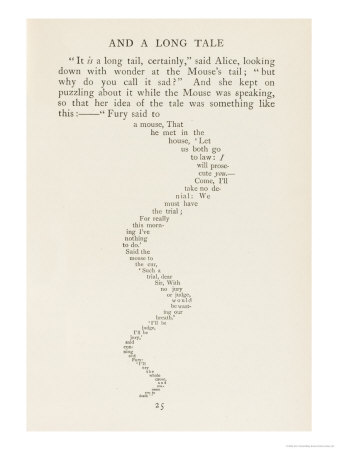
The long-running TV game show “Jeopardy” features Carrolian “answers” on a regular basis. Sadly, the three contestants often don’t know the appropriate “question” in response. But on the May 29th episode, the Mouse’s Tale was used as an example of “this kind of poetry” and a contestant correctly responded “what is concrete?”
Wikipedia also references the Mouse’s Tale when giving examples of concrete poetry. We’ve heard of a “poetry slam” but the Mouse’s Tale is more of a “poetry slab!”
The Dormouse in Chapter VII of The Annotated Alice (pgs. 93-95) gets the following footnote from Martin Gardner:
The British dormouse is a tree-living rodent that resembles a small squirrel much more than it does a mouse. The name is from the Latin dormire, to sleep, and has reference to the animal’s habit of winter hibernation. Unlike the squirrel, the dormouse is nocturnal, so that even in May (the month of Alice’s adventure) it remains in a torpid state throughout the day. In Some Reminiscences of William Michael Rossetti, 1906, we are told that the dormouse may have been modeled after Dante Gabriel Rossetti’s pet wombat, which had a habit of sleeping on the table. Carroll knew all the Rossettis and occasionally visited them.
This is the second blog post in a series for the LCSNA called Gardner’s Annotations Hyperlinked, in which we employ the mighty power of the internet to illuminate, investigate, and of course provide links for the footnotes from The Annotated Alice.
The only dormouse native to the British Isles is the Hazel dormouse, which is indeed more closely related to a squirrel than to a mouse. (The suborder Sciuromorpha contains chipmunks, squirrels, and dormice. Mice and rats are muroids.) Although dormire in Latin does mean “to sleep,” it might not be directly related to the etymology of “dormouse.” The Wiktionary‘s etymology: “From Middle English dormous, of uncertain origin. Possibly from dor-, from Old Norse dár (‘benumbed’) + mous (‘mouse’). … Although the word has come to be associated as an Anglo-Norman derivative of Old French dormir(‘to sleep’), no such Anglo-Norman word is known to have existed,” and it cites the Random House Dictionary as its reference. (The dormousian association with sleepiness seems to go back centuries – the Elizabethans apparently rubbed dormouse fat on the soles of their feet to induce sleep, according to The Sleepyhead’s Bedside Companion by Sean Coughlan. How could an animal both nocturnal and hibernating have any other reputation? We posted a cute viral video of a snoring dormouse a few months ago here.)
William Michael Rossetti (1829-1919)
As for Gardner’s one literary reference in his note, the Pre-Raphaelite memoir Some Reminiscences of William Michael Rossetti (1906), it’s widely available and has been reprinted multiple times in the past decade. Google Books has several accessible copies of the text: Vol. I here; Vol. II here. It is true that C.L. Dodgson knew the Rossetti’s and would hang out with them sometimes. It is also true that Dante Gabriel Rossetti owned several wombats (and some dormice and other exotic pets), and that one beloved wombat would entertain at dinner parties. However, it’s impossible that Gardner read in that specific book that Rossetti’s wombat “may have” inspired Carroll’s dormouse, because it’s neither written there nor true. In Volume I of Some Reminiscences, William Michael Rossetti describes some of the “beasts” Dante Gabriel kept in his garden, after which he describes his indoor pets:
From "Rossetti and his Circle" by Max Beerbohm. One of those animals is supposed to be a wombat.
…they were my brother’s companions day by day, and the wombat would follow at the housemaid’s heels when she went upstairs to make the beds. An anecdote is current of the wombat, and I accept it as only somewhat exaggerated – not untrue. My brother had asked, as he pretty often did, several friends to dinner; he himself never smoked, but for the satisfaction of his guests he had provided a box of superior cigars. The dinner over, he proceeded to produce the box. The box was there, but the cigars were gone: the wombat had made a meal of the entire assortment.
The Rossetti Family, photographed by Lewis Carroll (1863)
Hilarious! The wombat ate some fancy cigars. Sounds like a good party (except for the shortage of tobacco). He then goes on to describe several drawings of wombats by Edward Burne-Jones he owned, and of poetry by Christina Rossetti which mentions wombats as well. (“When wombats do inspire / I strike my disused lyre.”) Carroll is not mentioned in Volume I. Neither is any dormouse nor any of the Alice books ever mentioned in either volume of Some Reminiscences. In Volume II, William Michael Rossetti has one uninspiring paragraph about Carroll:
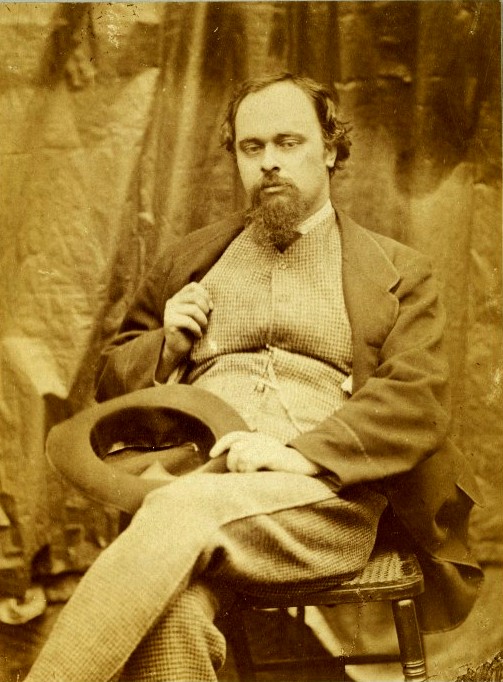
Lewis Carroll's photograph of Dante Gabriel Rossetti (1863)
One of the earliest of these [visiting authors] but I only saw him once or twice was the Rev. C. L. Dodgson, whom the English-speaking world knows under the name of Lewis Carroll. He was a skilful amateur photographer, and he took some few photographs of Dante Rossetti, and of other members of the family. He continued keeping up some little acquaintance with Christina till the close of her life, sending her his successive publications. My reminiscence of Mr. Dodgson is so slight and indeterminate that it would be vain to attempt any exactness of description. Suffice it to say that he impressed me mainly as belonging to the type of ” the University Man ” : a certain externalism of polite propriety, verging towards the conventional. I do not think he said in my presence anything ” funny ” or quaint.
The only mention of wombats in Volume II is a reference to his unsuccessful attempt to purchase one in Sydney.
So where did Martin Gardner learn that Rossetti’s wombat inspired Carroll’s Dormouse? I don’t know, but he didn’t invent the idea. That honor goes to the Pre-Raphaelite painter Ford Madox Brown. The artist’s grandson, Ford M. Hueffer (who changed his name to Ford Madox Fordand became a 20th Century novelist) wrote the book on Madox Brown in 1896: Ford Madox Brown: a record of his life and work. He also describes the Rossetti zoo and some legendary parties:
The beast that made the greatest impression, at least on Madox Brown, was the singularly inactive marsupial known as the wombat – an animal that seems to have exercised a latent fascination on the Rossettian mind. On high days and holiday banquets it occupied a place of honour on the épergne in the centre of the table, where, with imperturbable equanimity, it would remain dormant. On one occasion, however, it belied its character. Descending unobserved, during a heated post-prandial discussion, it proceeded in leisurely fashion to devour the entire contents of a valuable box of cigars, achieving that feat just in time for the exhaustion of the subject under consideration and consequent attention to things mundane.
If Madox Brown may be believed, the wombat of Rossetti was the prototype of the dormouse in ‘Alice in Wonderland,’ the author of which beloved work was a frequent visitor of Rossetti’s household at Chelsea. The ‘ Alice ‘ books exercised an even greater fascination over Rossetti and for that matter over Madox Brown than the historic wombat had done …
Note Ford’s subtle skepticism of his grandfather’s word. I found the final nail in the coffin to the Wombat-Dormouse theory in a 2003 lecture by Angus Trumble, the Harold White Fellow at the National Library of Australia, Canberra. Trumble adds some Australian local knowledge to his scholarship, in a talk called “Rossetti’s Wombat: A Pre-Raphaelite Obsession in Victorian England.”
A crystal épergne ($160) from the Horchow Collection, 20"H x 17"W x 14 1/4"D. Adult wombats are approx. 39" long.
…James McNeill Whistler invented a silly story about how the wombat had perished after eating an entire box of cigars. Ford Madox Brown thought that Rossetti’s habit of bringing the wombat to dinner and letting it sleep in the large épergne or centrepiece on the dining room table inspired the dormouse in the tea-pot incident at the Mad Hatter’s Tea Party in Alice’s Adventures in Wonderland. This is also impossible because Lewis Carroll wrote that chapter in 1863, and the novel with its famous illustrations by John Tenniel was published two years later in 1865. As my colleague David Marshall has also pointed out, either Rossetti’s épergne was enormous, or the wombat was dramatically small.
He says “impossible,” because his research shows that Dante Rossetti had bought the first of his pet wombats in 1869. I don’t know how big an épergne usually is, but dormice certainly fit more easily into teapots than wombats do. Do wombats fit in teapots? Do teapots fit in wombats?
"Dormouse surnamed Dwanging," by Dante Gabriel Rossetti, c. 1834 (age 6), pencil on paper.
Several final discoveries about cute animals owned by Pre-Raphaelites before we go. One of the earliest drawings by Dante Gabriel Rossetti was of a dormouse – he drew pictures of his pet dormouse named “Dwanging” when he was about six years old. It looks to me more like a cave painting than anything drawn by any pre-tween I know. In Dante Gabriel Rossetti: his family-letters, Vol. I, his brother also describes his pet hedgehog, which also hung out on the family dinner table. So Dante was into pets long before he acquired his own large collection of strange creatures as an adult. What became of the wombat? It died.
"I never reared a young Wombat / To glad me with his pin-hole eye, / But when he most was sweet & fat / And tail-less; he was sure to die!" Dante Gabriel Rossetti, 1869
"May I please sit on your épergne?"
American artist James McNeill Whistler’s version of the story (from this early biography) has the wombat skeleton discovered in the cigar box. (A humongous cigar box?) I wouldn’t attempt to guess how Rossetti’s wombat actually died, but eating tobacco is extremely poisonous. According to the Wikipedia, “The LD50of nicotine is 50 mg/kg for rats and 3 mg/kg for mice. 0.5-1.0 mg/kg can be a lethal dosage for adult humans, and 10 mg (0.1mg/kg) for children.” A cigar contains around 150 mg of nicotine. Wombats weigh between 20 and 35 kg. Eating even a single cigar would very likely kill a wombat. Again, I’m not trying to perpetuate the theory that Rossetti’s wombat died from eating cigars at the dinner party in question. But either William Michael Rossetti’s anecdote is more than “only somewhat exaggerated,” or it didn’t end well for the wombat.
The Lewis Carroll Society of North America’s fantastic Spring 2012 meeting yesterday in Cambridge, Mass., was followed today by a gathering to view the Lewis Carroll collection of former president Alan Tannenbaum and his wife Alison Tannenbaum, at their beautiful house in Chelmsford, Massachusetts. Sandwiches were served, containing what I hope now was beef and turkey meats. In attendance were three of the four authors of this strange new sequel to The Hunting of the Snark, titled The Haunting of the Snarkasbord:Alison Tannenbaum, Charlie Lovett, and August A. Imholtz, Jr. Not physically present was illustrator Byron W. Sewell. It is published, of course, by Evertype’s Michael Everson, a man who would publish Alice’s Adventures in Wonderland translated into Dothraki (a fictional language created for HBO’s A Game of Thrones, based on the novels of George R. R. Martin) if he could. (Yes, that was an attempt to inspire aspiring Dothraki translators out there.) Everson writes:
Sometimes a publisher is given a gift for his unbirthday. Not long ago, four noted Carrollians came to me with a proposal for a dark, humorous parody of The Hunting of the Snark concerning what followed the Baker’s vanishing and the Crew’s continued hunt for a snark on Snark Island. How could one refuse?
Alison Tannenbaum wrote the poetry in Snarkasbord: A Crewsome Choice and also wrote notes on Byron W. Sewell’s illustrations for it. An introduction and Gardnerian-style notes have been written by August A. Imholtz, Jr in his inimitable style.
This edition marks the first public publication of the poems “The Booking”, “The Recrewting”, and “The Sailing”—the three “Missing Fits” composed by Charlie Lovett. These were originally written for a secret English Snarkian Society, and were mentioned by Selwyn Goodacre in his “The Listing of the Snark” in Martin Gardner’s final version of The Annotated Hunting of the Snark. Hitherto, they have only ever been seen by the members or guests of the Society.
In addition to his wonderful illustrations, Byron W. Sewell has contributed an original short story, “Forks and Soap”, which tells what happened to the Baker from the viewpoint of the Boojum. Like Lovett’s parodies, this short story has never before been seen by the public; it was issued in a very limited number to his Carrollian friends.
If you have been lucky enough to get hold of The Haunting of the Snarkasbord but have never read The Hunting of the Snark, please see here.
Tannenbaum is herself a notorious Cook (although she is known to use too much pepper) and she and Imholtz created the cookbook Alice Eats Wonderland published in 2009. Since the Snarkasbord poem seems to have a bit of Donner Party in it, let’s hope a sequel to Alice Eats Wonderland does not cater to the tastes of the Cannibal Club(with whom Lewis Carroll dined on 21 January 1868 and described in his diary as a “heinous society led by the reprobate [Sir Richard] Burton.” (Thank you, August, for the entertaining introduction.) The Haunting of the Snarkasbordsells for $15.95 at Evertype.
Children’s author Lil Chase compiled a list of her favorite made-up words in the Guardian today. What’s interesting is how many of the words, invented fancifully by literary wordsmiths, have simply become normal English words. ‘Muggle,’ from J.K. Rowling, now is used not only to mean “a non-magical person,” but more widely as being a person outside of some specific interest. Lil Chase lists A.A. Milne’s “heffalump,” Orson Welles’ “ungood,” and others, and of course Carroll:
7. Galumphing
After slaying the terrible Jabberwock, the boy in Lewis Carrol’s poem “left it dead, and with its head / he went galumphing back.” It’s thought to be a combination of the words “gallop” and “triumphant”. However, modern-day usage is different: picture a sort of ungainly, graceless way of walking with difficulty, the gait of a grumpy teenager, perhaps; perhaps how you might walk if you were dragging a giant jabberwock’s head.
10. Cromulent
My favourite made up word comes from The Simpsons and it describes all of the words above. It’s “a dubious or made up word, term, or phrase that is entirely plausible because it makes logical sense within existing language conventions”. But it’s best defined by simply quoting the script:
As two teachers stand at the back of the auditorium someone recites Springfield’s motto: A noble spirit embiggens the smallest man. Teacher 1:Embiggens? I never heard that word before I moved to Springfield. Teacher 2:I don’t know why. It’s a perfectly cromulent word.
Cromulent is an amazing word. I can’t believe I didn’t know it before. It’s like the word ‘sesquipedalian,’ which is a long word which means “a long word.”
Art by John Turner of Creative Goods Design & Supply, for Wonderland, in a New York Times special feature "Adventures in Communicating a New Alice"
The reviews have been coming in all weekend for Frank Wildhorn’s Wonderland: A New Broadway Musical (the musical formerly known as Wonderland: A New Musical and Wonderland: A New Musical Adventure.) Wonderland‘s website quotes the New York Times: “INSPIRATIONAL, FANCIFUL & GROOVY.” The Times’ review by Charles Isherwood was actually a bit more nuanced, but I suppose “…the desire to create a traditional narrative arc from the unruly dreamscape of Carroll’s original results in a convoluted story line pitting the good guys against the bad…” doesn’t fit on a marquee. Neither would “‘Wonderland’ transforms Alice’s surreal wanderings into a contemporary parable about reconnecting with your inner child and other watery truisms of the self-help industrial complex.” Kudos to Isherwood for pointing out that Alice’s “increasing exasperation to find her way home” is more Oz’s Dorothy than Alice: “a preoccupation that didn’t seem particularly urgent to the polite, spirited youngster in Carroll’s original.”
However, Adam Feldman’s proper panning for TimeOut New York was a spectacular parody of the Jabberwocky. It’s so good, I can’t resist posting it here in full:
’Tis Wildhorn, and the hapless cast
Does direly gambol on the stage.
All flimsy is the plot half-assed,
Not right for any age.
Beware of Wonderland, I warn!
The jokes that cloy, the scenes that flop!
Beware the humdrum words and scorn
The spurious, bland rock-pop!
The book’s a torpid bore in which
A newly single mom (Dacal)
Gets tested, see, by a journey she
Begins with quite a fall.
This modern Alice lands (ker-splat!)
In Wonderland, and banters some
With rabbit, caterpillar, cat
(In order: twee, dull, dumb).
She also meets a huffish Queen
Of Hearts (well-costumed Mason), and
A lady Hatter (Shindle, keen)
Who wishes to command.
These cartoon Carroll singers screech
The busy Wildhorn-Murphy score,
Which oft suggests a loud, high reach
At songs you’ve heard before.
A White Knight (Ritchie) does enact
A boy-band number that’s a lark—
But then comes the worst second act
Since poor Turn Off the Dark.
Act Two: Boo! Boo! And through and through
This Wonderland’s both slick and slack.
Dacal et al. can only do
So much to save the wrack.
And why has Wonderland been made?
Answer me that, director Boyd!
From captious gays to children dazed:
By all it’s unenjoyed.
’Tis Wildhorn, and the hapless cast
Does direly gambol on the stage.
All flimsy is the plot half-assed,
Not right for any age.
Thank you, Mr Feldman. If the LCSNA gave out an annual award for Jabberwocky parody (and we should, dash it all!) this would be a heavy favorite.
I’d also like to take this moment to mention that the actor playing the R&B-singing Caterpillar has an amazing name: E. Clayton Cornelious.
Author Richard Conniff wrote an entertaining post for the New York Times blog Opinionator yesterday. It starts off at sea in a Sieve with the Jumblies and ends in the Tulgey Wood, all to discuss the relation between the Nonsense poets’ zoology and the age of 19th Century scientific exploration, which turned up many fanciful new creatures. “Charles Darwin himself could sound as whimsical as Lewis Carroll,” writes Conniff. Read the whole article here, and here’s an excerpt:
A pigeon from one of Edward Lear’s books.
[...] But it never occurred to me that there might be a direct connection between the two worlds of nonsense verse and biology. Then one day I picked up an old print of a tropical pigeon species and noticed the “E. Lear” in the bottom corner. Though he is celebrated today mainly as the author of such works as “The Owl and the Pussycat,” Lear had started out as a naturalist. His first book, “Illustrations of the Family of Psittacidae, or Parrots,” drew favorable comparisons with Audubon when he published it in 1832, at age 19.
Like many naturalists, Lear described the natural world not just in literal-minded scientific detail, but also in fanciful doodles and verse. And when this blossomed into books for children, he often dispatched his characters, like naturalists, on wild explorations to the back of beyond. He also had them devote considerable energy to collecting the oddities of the country:
And they bought a Pig, and some green Jack-daws,
And a lovely Monkey with lollipop paws,
And forty bottles of Ring-Bo-Ree,
And no end of Stilton Cheese.
Nonsense was almost a byproduct of natural history. The twin themes of exploration and taxonomy, were “present in the genre as a whole, even in Lewis Carroll, who had no special interest in the subject,” according to the French scholar Jean-Jacques Lecercle, in his 1994 book “Philosophy of Nonsense”: “The reader of ‘Alice’s Adventures in Wonderland’ is in the position of an explorer: the landscape is strikingly new … and a new species is encountered at every turn, each more exotic than the one before. Nonsense is full of fabulous beasts, mock turtles and garrulous eggs.”
While not impossible (Dodgson didn’t die till after the advent of sound recording), I was skeptical when this blog 22 Words claimed to have a recording of “Lewis Carroll reading ‘Jabberwocky.’” But I see they updated it with the comment “Oops! Sorry…This isn’t Lewis Carroll reading. Not sure how I made that mistake…” I can guess how they made the mistake: they had embedded the sound only from this strange YouTube animation. Its creator, Jim Clark, explains himself thusly: “Here is a virtual movie of Lewis Carroll reading his much loved poem Jabberwocky. The poem is read superbly by Justin Brett.”
There’s no known voice recordings of Carroll are there?
The October 2010 issue of the tri-quarterly poetry journal Blue Unicorn ($7), out of Kensington, California, contains an Alice-themed sonnet, “Hatteras Time,” by Gregory Perry. It has a quotation from Alice and the Hatter’s conversation on time as its epigram. The poem begins “We’re mad as hatters down in Hatteras.” Ruth Berman reports that the piece “draws on imagery of teatime, the Queen of Hearts, a lack of ‘much of muchness to pursue,’ and having ‘buttery time to kill.’”
There is Thingumbob shouting! Mahendra Singh’s beautiful new illustrated version of The Hunting of the Snark is being released tomorrow, Tuesday, November 2nd (and we refuse to make any Election Day analogies) from Melville House Publishing. You can still pre-order it today for $10.08 on Amazon with free shipping (where it’s listed as a “graphic novel,” although where is the line between a graphic novel and a book with many, many pictures and conversations?) Singh, an LCSNA member and an editor of the Knight Letter, has been blogging about the creative process of this book for years with tons of sneak-peaks of the art at justtheplaceforasnark.
In 1879, Charles Lutwidge Dodgson–a.k.a. Lewis Carroll–published the classic “nonsense” poem, The Hunting of the Snark. Though often outshined by Carroll’s prose works like Alice’s Adventures in Wonderland, Snark is beloved by Carroll fans and has been adapted in numerous iterations since it was originally published.
In November, Melville House is publishing the latest iteration, a lovely new graphic novel edition of The Hunting of the Snark, illustrated by the artist Mahendra Singh. (Singh has been blogging about the process of adapting this famous work over at justtheplaceforasnark–I encourage anyone who considers themselves aficionados of Carroll or graphic novels to check it out. His commentary about the process is incredibly fun and often brilliant.)
When you’re publishing something that’s already so well known, there’s no shortage of adaptations and interpretations out there. Each tends to say something not just about the original work, but about the time and place it was adapted. Yesterday I found this wonderful audio clip of Boris Karloff doing a reading of Snark. It’s lovely to hear Karloff’s eloquent rendering, to let it take you back to his time as he ruminates on Carroll’s playful language, and get wrapped up in all the “nonsense”…