
The Blog of the LCSNA

Burbles

Page 88 of 121

The Blog of the LCSNA

“In essence, I think I am, still, this child-self so like an American cousin of Lewis Carroll’s Alice.”

This essay by Joyce Carol Oates, “In the Absence of Mentors/Monsters: Notes on Writerly Influences,” was actually published in Narrative Magazine in Fall 2009, but it’s now available online at the Huffington Post. Read this whole essay here, and I’ve excerpted a few relevant passages:

Early Influences. Often it’s said that the only influences that matter greatly to us come early in our lives, and I think that this must be so. Of the thousands–tens of thousands?–of books I’ve probably read, in part or entirely, many of which have surely exerted some very real influence on my writing life, only a few shimmer with a sort of supernatural significance, like the brightest stars in the firmament: Lewis Carroll’s “Alice’s Adventures in Wonderland” and “Through the Looking-Glass,” Frances Hodgson Burnett’s “The Secret Garden,” and “The Gold Bug and Other Tales” by Edgar Allan Poe–the great books of my childhood.

[…]

Most of the children’s storybooks and young-adult novels my grandmother gave me have faded from my memory, like the festive holiday occasions themselves. The great single–singular–book of my childhood, if not of my entire life, is “Alice’s Adventures in Wonderland” and “Through the Looking-Glass,” which my grandmother gave me when I was eight years old, and which, with full-page illustrations by John Tenniel, in a slightly oversized edition with a transparent plastic cover, exerted a powerful influence on my susceptible child’s imagination, a kind of hypnotic spell that lasted for years.

Here is my springboard into the imagination! Here is my model of what a storybook can be.

I was too young for such exalted thoughts, of course. Far too young even to grasp that the name stamped on the spine of the book–Lewis Carroll–was the author’s name, still less that it was the author’s pen name. (Many years would pass before I became aware that the author of the “Alice” books was an Oxford mathematician named Charles Dodgson, an eccentric bachelor with a predilection for telling fantastical stories to the young daughters of his Oxford colleagues and photographing them in suggestive and seductive poses evocative of Humbert Humbert’s nymphets of a later, less innocent era.) My enchantment with this gift began with the book itself as a physical and aesthetic object, quite unlike anything else in our household: both Alice books were published in a single volume under the imprint Illustrated Junior Library, Grosset & Dunlap (1946). Immediately, the striking illustrations by John Tenniel entered my imagination, ranged across the field of the book’s cover–back and front–in a dreamlike assemblage of phantasmagoric figures as in a somewhat less malevolent landscape by Hieronymus Bosch. (I still have this book. It is one of the precious possessions in my library. What a surprise to discover that the book that loomed so large in my childhood imagination is only slightly larger than an ordinary book.)

The appeal of “Alice” and her bizarre adventures to an eight-year-old girl in a farming community in upstate New York is obvious. Initially, the little-girl reader is likely to be struck by the fact that the story’s heroine is a girl of her own approximate age who confronts extraordinary adventures with admirable equanimity, common sense, and courage. (We know that Alice isn’t much more than eight years old because Humpty Dumpty says slyly to her that she might have “left off” at seven–meaning, Alice might have died at seven.) Like most children, Alice talks to herself–but not in the silly prattling way of most children: “ ’Come, there’s no use in crying like that!’ said Alice to herself rather sharply; ‘I advise you to leave off this minute!’ ” (Obviously, Alice is echoing adult admonitions–she has interiorized the stoicism of her elders.) Instead of being alarmed or terrified, as a normal child would be, Alice marvels, “Curiouser and curiouser!”–as if the world so fraught with shape-changing and threats of dissolution and even, frequently, cannibalism were nothing more than a puzzle to be solved or a game to be played like croquet, cards, or chess. (Alice discovers that the Looking-Glass world is a continual game of chess in which, by pressing forward, and not backing down in her confrontations with Looking-Glass inhabitants, she will become Queen Alice–though it isn’t a very comfortable state pinioned between two elderly snoring queens.) The “Alice” books are gold mines of aphoristic instruction: “Who cares for you? . . . You’re nothing but a pack of cards!” Alice cries fearlessly, nullifying the authority of malevolent adults as, at the harrowing conclusion of “Looking-Glass,” she confronts the taboo-fact of “cannibalism” at the heart of civilization… [Continue reading here.]

Share

Free Downloads of Storypods Nonsense Contest Winners

Andrew Sellon, President of the Lewis Carroll Society of North America, has partnered with Oxford-based Storypods Audiobooks to provide free audio downloads of the two poems that won Storypod’s 2010 Nonsense competition.  Storypods launched the contest as a tribute to Lewis Carroll, and received many entertaining submisssions.  To listen to the winners and download the audio files, click the image on the right.  Enjoy!
Share

Do feminists slay Jabberwocks?

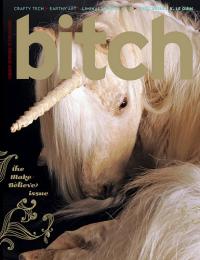
Issue 48, Fall 2010, of Bitch Magazine, “The Make-Believe Issue,” includes “Alice in Adaptation-Land—How wanderer Alice became warrior Alice, and why.”

In the well-written article, Kristina Aikens makes the interesting point that the Carroll’s curious Alice is more of a feminist icon than Burton’s Alice that puts on armor, kills the Jabberwock, and seeks to colonize China.

Share

New Pop-up: Il était une fois…

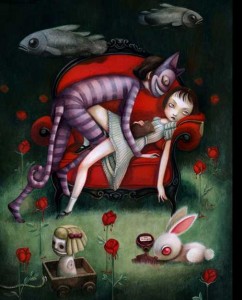
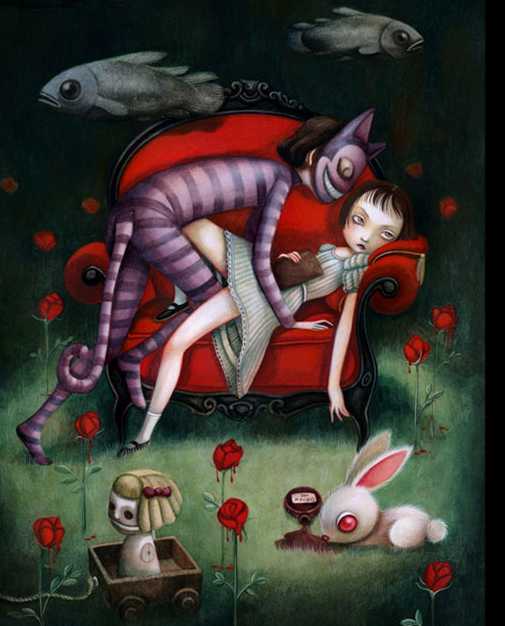
“Eat Me, Drink Me” by Benjamin LaCombe
"Eat Me, Drink Me" by Benjamin Lacombe

Eight classical tales evoked by a double page with ingenious mechanism, in a magnificent book which associates technical exploit and artistic talent. Find the characters of the most famous tales: Alice, Pinocchio, Sleeping Beauty , Blue Beard, Peter Pan, The Little Red Riding Hood, Mrs butterfly , Poucette staged by Benjamin Lacombe and in volume by José Pons. At the end of the book, Jean Perrot’s point of view, an expert of the tales and the youth image, will come to light the work.

Folow the White Rabbit….

More informations here :
http://benjaminlacombe.hautetfort.com/
http://www.benjaminlacombe.com/

– from the blurb on YouTube, and what a high-class trailer this book has!

Share

Marilyn Manson’s Phantasmagoria disappears like a little ghost

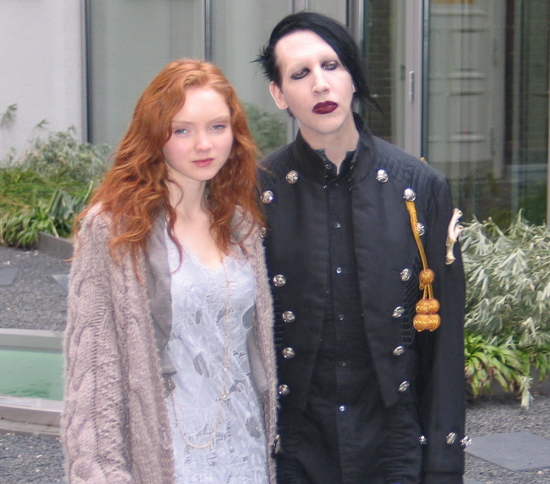
Lily Cole & Marilyn Manson

Many Lewis Carroll lovers have been awaiting Marilyn Manson’s promised Dodgson movie with varying degrees of dread. The latest news, according to contactmusic.com, is that the studio has shelved the project:

Viewers were left shocked after disturbing clips from The Phantasmagoria: The Visions of Lewis Carroll hit the internet, with the 22 year old [Lily Cole] appearing as Alice [Liddell] in a story about the Alice In Wonderland author.

Studio bosses have since decided to shut down the entire project, which was directed by goth rocker Marilyn Manson and also stars Tilda Swinton.

A source tells Britain’s Mail on Sunday, “The trailer caused such a backlash that a decision was made to close down the project. It’s unlikely it will ever see the light of day.”

According to the publication, the film is now officially on ‘indefinite production hold’.

Of course, sometimes studio suppression can increase interest (remember Terry Gilliam’s Brazil?), especially with a famous director and juicy controversy – but, at least for the time being…. phew?

Share

O Absalom, my caterpillar!

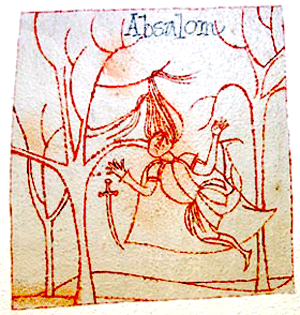
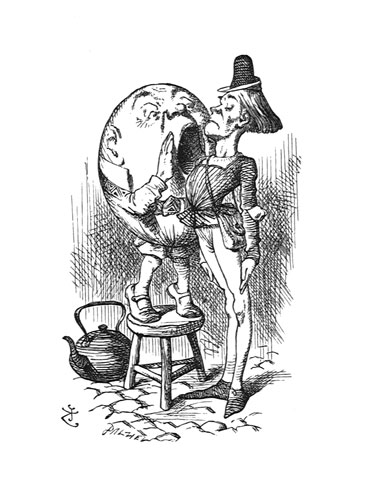
A writer named Steve A Wiggins (“part-time Academic” & “failed priest” according to his bio) wonders on his blog Sects & Violence in the Ancient World about screenwriter Linda Woolverton’s choice in naming the caterpillar the biblical name Absalom:

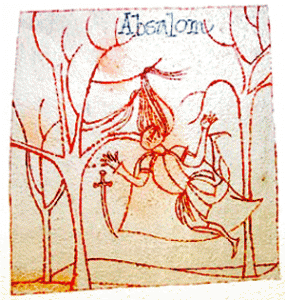
Supposing this to be nothing more than the reassignment of a fated biblical name associated with failed attempts at kingship, I simply let the reference pass. Until the chrysalis scene. There he was, Absalom hanging from a plant, just like David’s son swayed from a tree according to 2 Samuel. This mysterious scene in the battle of Ephraim Forest had captured my attention before when I wrote an article on Absalom, eventually published in the Journal of Northwest Semitic Languages.

Read the whole interesting blog post, Ashtar in Wonderland.

Share

Other Carrollian Blogs

For all you Carrollian blog-happy readers, we’ve added a new page to the LCSNA site that brings together blog links listed in various other places of the site.  This way, if you’re a fan of following blogs (in addition to this one, of course!), you now have one stop shopping.  As always, please keep in mind that listing a site doesn’t necessarily mean we endorse its contents; we merely provide the links for your convenience and enjoyment.  You can access the new “Carrollian Blogs” page from the Lewis Carroll menu of our site, or by clicking here.

If you know of more Carroll or Alice-themed blogs, please send us the link(s)!

Share

Theater Review: 11th Hour Ensemble’s Alice

There’s a new theater piece called Alice, premiering tonight at the Theatre of Yugen, 2840 Mariposa Street in San Francisco (running September 9th through 19th), directed and “imagined” by Allison Combs. As a work of “movement theatre,” it’s about 60% interpretive dance and 40% dialogue, easily juggling different genres of theater with different types of music, and varying levels of seriousness & silliness.

Alice, in her traditional blue outfit but played by a leggy adult actor/dancer (Megan Trout), is already exhausted on the stage when the audience is allowed to enter. (“Is that Alice?” asked a young girl behind me, Alice having already silently begun her opening number while an usher noisily hobbled past her to turn off a loud fan & the audience settled in.) This Alice starts out with grown-up anxieties, obsessive-compulsively counting numbers, and reassuring herself repeatedly “okay, okay, okay.” In contrast to the wildness she’s about to encounter, we realize that her troubled state of mind at the beginning is her supposed normalcy.

Then, instead of a white rabbit, she is shaken from her routine by a single playing card falling from the sky. A tribe of five strange savages in rags starts to mess with her by taking her thru the mind-and-body-changing adventures of Wonderland, loosely inspired by the stuff that happens in Carroll’s book. (While Alice was exploring the corridor, before it really gets going, the child behind me declared “This is upsetting because it’s boring.”) Growing, shrinking, falling, mushrooms, being stuck in a house, scary forests, and all manner of psychedelic abstractions are created by the weird tribe with their flexible interlocking limbs, in extremely creative ways. Only using their bodies, a caterpillar sits on a mushroom, and when he sucks on one of their fingers, the whole mushroom inhales & exhales. It’s most fun during the wild dance numbers, with their very cool choreography; it drags a little during the dialog, which like so many Alice in Wonderland adaptations, is always a lot less clever than Carroll’s original. For some reason, their amazing Cheshire Cat, very feline & Kabuki-ish, stuck closer to Carroll’s words, and was consequently much more powerful.

After Alice has gone native, a new square-peg (named Lewis) also finds himself lost in Wonderland, and by this time Alice has already become one of the weird savages. Lewis’s unhappy anal-retention makes us realize what Wonderland is to these people: everything ‘other’ in American society. Their Wonderland is part hippie, part hipster, part Burning Man, part mushroom trip, totally gay, multi-cultural and sexy. It has games with no rules, self-examination, community, humor, and of course lots of dancing and singing. It’s also dirty. Uptight Lewis rejects it outright, and even Alice eventually wakes up. But she’s definitely dirtier than before her trip to Wonderland (“Is she dripping sweat?” asked the child behind me.)

Share

Alice in the Redwoods

Hiking with Atmos Theatre’s Theatre in the Woods

Hiking with Atmos Theatre's Theatre in the Woods

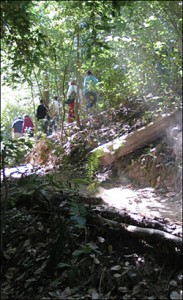
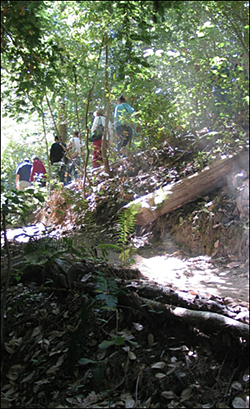
Atmos Theatre, a volunteer-run theater company in San Francisco, has adapted Alice in Wonderland for its ninth season of “Theatre in the Woods.” It’s been happening every Saturday & Sunday in August and through September 19th in Woodside, California (a few cities south of San Francisco.) “‘Alice in Wonderland’ is performed as part of a guided hike through our redwood-filled forest property.” It sounds beautiful but, unfortunately, the entire run is completely sold out!

The original adaptation is by Brian Markley and directed by Amy Clare Tasker.

Theatre in the Woods features two stages and a variety of performance spots along our trails. Our Main Stage, nestled with a beautiful backdrop of redwood trees behind it, features natural benches made out of redwood planks and stumps. Our Amphitheatre Stage at Harrington Creek features natural amphitheatre seating carved out of the hillside. We provide blankets on the earth benches for a perfect view of the forest stage opposite the creek. And the acoustics are fantastic!

Share