The Blog of the LCSNA

Burbles

Page 84 of 121

The Blog of the LCSNA

Possibly Lousy Documentary on the Market

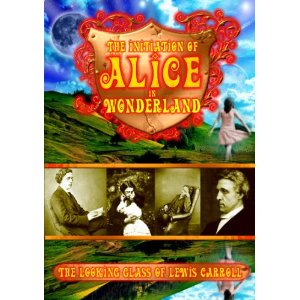
This has been out for a year, but it’s the first time it came across our desk. The LCSNA member who forwarded it to us suspected that it was “execrable.” It’s a 2009 low budget documentary called Initiation of Alice in Wonderland: The Looking Glass of Lewis Carroll ($24.95) directed by Not Provided and starring Artist Not Provided. (Personally, I prefer their earlier work.) I would never judge harshly without seeing it, but luckily there are some Amazon.com customer reviews which have done that for me, with some disturbing facts about the movie’s mistakes:

“Worse than just a boring, repetitive ripoff off old biographies, this film ‘stars’ the director’s daughter mugging for the camera over and over. The director’s own bias towards the mystical warps Lewis Carroll into some chemical character. The most awful part here is the terribly Photoshopped picture of Lewis Carroll embracing and kissing Alice Liddell !? This is shown maybe 10 times throughout the film. If there is a Liddell or Dodgson estate extant, they should sue. ” -B. T Weddleton

“…it is filled with misinformation. For one example, every time the narrator discusses the family of Alice Liddell, a picture is shown of Carroll with the wife and children of George MacDonald, another Victorian author.” -Melody Green

Anyone else who has seen it, please leave your thoughts in the comments. And, since there’s no record of it on imdb or elsewhere, can anyone supply a name for the anonymous people responsible for this project?

Share

CNN Linguist cringes at 2010’s portmanteaus

Linguist Robert Beard (the author of The 100 Most Beautiful Words in English, which I’ve heard is a bit prejudiced against the Anglo-Saxon) complains in CNN’s 2010 Year in Review that his sacred English Language took another “fresh beating” this year, discussing the prevalence of new portmanteau words.

New words and constructions like “Obamacare,” “WikiLeaks,” “lamestream,” “shovel-ready,” “sexting,” and many others like them were uttered or typed and in minutes spread across the globe.

Makes one wonder: Have we been beating English into a new shape, or just beating it up? There is, after all, a difference between the games we play with new words, which can be amusing — even though they often get out of hand — and the more subtle changes that often lead to confusion and offensiveness.

Beard then goes on to cite Carroll and relay the modern political history of portmanteau malapropisms:

Coined by Lewis Carroll, the term “portmanteau word” is one that carries two words inside itself. Portmanteaus may simply be funny games we play with words or errors that we should avoid.

When we speak, we go to our mental dictionaries for the right words. If we find two words with similar meanings or pronunciations, we have to make a split-second choice of which to use. President George W. Bush’s mind once found itself having to choose between “miscalculated” and “underestimated” as he spoke, but failed to reach a decision in time, so he uttered “misunderestimated”.

Sarah Palin’s famous portmanteau “refudiate” is similar. “Refudiate” is a speech error that many others before her have made by blending “refute” and “repudiate.” That it has been around for ages but has yet to make it into a dictionary tells us that it is a speech error we should stop discussing and let pass for what it is: a funny but erroneous portmanteau.

Portmanteaus may be “funny games” (I’ll take that as a compliment), and annoying ones can make it into mainstream parlance quickly thanks to new media, but there’s no need to be curmudgeonly about a year which saw many strange and entertaining new coinages. Palin’s defense of her accidental wordsmithing (which was later named 2010 Word of the Year by the New Oxford American Dictionary) was to tweet: “‘Refudiate,’ ‘misunderestimate,’ ‘wee-wee’d up.’ English is a living language. Shakespeare liked to coin new words too. Got to celebrate it!”

Share

Occupational Hazard

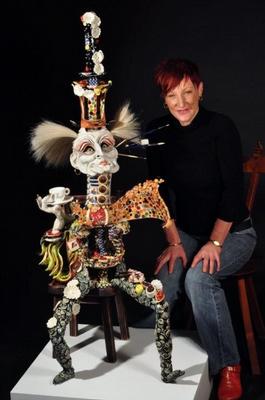
Rebecca Shawyer with “Occupational Hazard”
Rebecca Shawyer with "Occupational Hazard"

Congratulations to Rebecca Shawyer, an artist from Cable Bay, New Zealand, for winning the People’s Choice Award at the 2010 Portage Ceramic Awards. Linda Laird reports in the The Northern Advocate:

Ms Shawyer’s version of Lewis Carroll’s Mad Hatter is called “Occupational Hazard”, a delightful, and according to the judges “slightly disturbing”, figure which made a striking statement among the less animate ceramic works in the country’s prestigious pottery contest.

That the piece was also voted the viewers’ favourite at the exhibition at Lopdell House, Titirangi, was the icing on the cake, as it were. Ms Shawyer’s previous career was largely spent in Europe as a pasticerra, or sweet pastry chef, specialising in pastiage, the art of making flowers and decorations with sugar paste.

“Typically most entrants stem from a potting background,” Ms Shawyer said of the Portage awards.

“The point of difference in my work is that I do not.

“The patisserie adorning my hatter offers a suggestion of a tea party, but more importantly acknowledges my past occupation.”

Ms Shawyer said that in times past many hatters went mad due to mercury poisoning from the chemical soaking cheaper furs.

“I allude to the madness in other occupations as well, particularly artists by referencing Duchamp in the signing of a readymade, and Van Gogh by eliminating an ear, replacing it with brushes and a loose screw.”

Share

We’re mad as hatters down in Hatteras

The October 2010 issue of the tri-quarterly poetry  journal Blue Unicorn ($7), out of Kensington, California, contains an Alice-themed sonnet, “Hatteras Time,” by Gregory Perry. It has a quotation from Alice and the Hatter’s conversation on time as its epigram. The poem begins “We’re mad as hatters down in Hatteras.”  Ruth Berman reports that the piece “draws on imagery of teatime, the Queen of Hearts, a lack of ‘much of muchness to pursue,’ and having ‘buttery time to kill.’”

Share

& now, Karl Rove as Alice

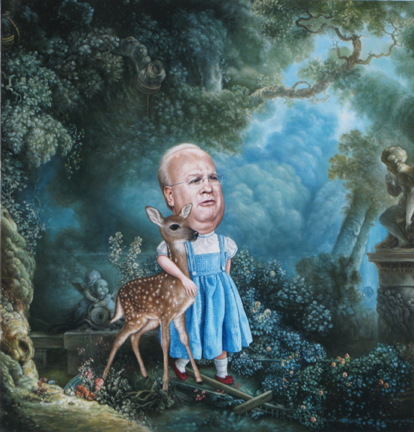
“Perfect Happiness” by Michael Caines, oil on canvas, 48″ x 46″
"Perfect Happiness" by Michael Caines, oil on canvas, 48" x 46"

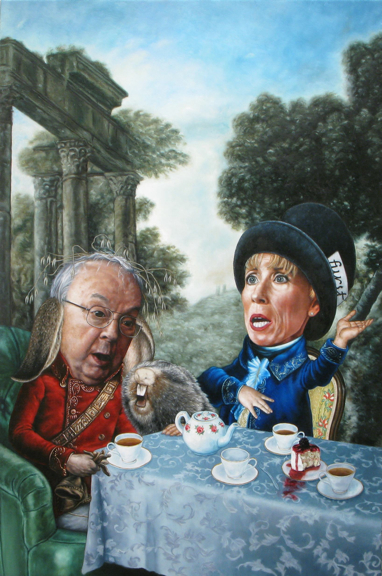
And a Happy New Year! The past year in political cartoonage has seen Palin and others as Alice. Now Canadian artist Michael Caines has Karl Rove in blue dress. (Rove was political strategist for George W. Bush and is now a pundit for Fox News.) The show “Perfect Happiness,” named after the Rove painting, runs through December 31st at the Mulherin Pollard Projects in Manhattan, 317 Tenth Ave. The art is for sale from $1,200 up to $10,000. There’s some disagreement between the Bloomberg News and LCSNA members as to what exactly Karl Rove is supposed to be (not to mention why) in that painting. Bloomberg writer Katya Kazakina refers to Rove as “dressed as Dorothy from ‘The Wizard of Oz’” and the image caption says he “wears a dress while embracing a Bambi-like deer.” Cindy Watter differs: “The scene isn’t Bambi-like; it is clearly taken from TTLG.” Please leave your analysis in the comments, as well as any identification of the people in the Tea Party below. More of Caines art, including some other Carrollian inspiration and Kim Jong Il in a ball gown, at mulherinpollard.com.

"Tea Party" by Michael Caines, oil on panel, 36" x 24"
Share

Alice Through The Looking Glass on the Moscow Stage

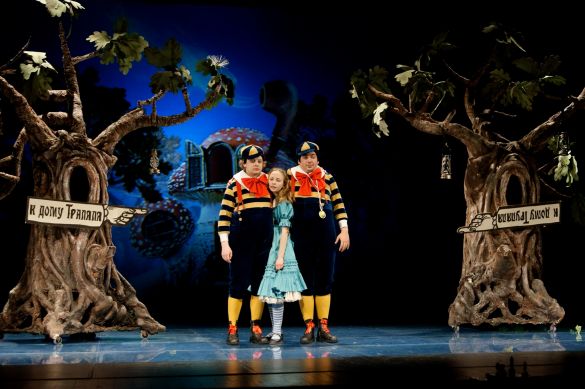
If you’re in Russia this winter, warm up with a new production of “Alice Through The Looking Glass” at the Fomenko Studio Theatre at at 29 Naberezhnaya Tarasa Shevchenko, on December 29th and 31st. John Freedman’s review in the Moscow Times raves about the “visually beautiful production”. Freedman also complains about the slow pace:

[…] Carroll’s rich and inventive language, translated here by Nina Demurova, occasionally paralyzes the action. Alice’s meeting with Humpty Dumpty (rendered in Russian as Shaltai-Boltai and played by Vasily Firsov) seems particularly trapped.

Share

A Jóia de Alice

If you’re in Portugal this weekend, there are seven paintings on display by artist and scholar Maria Antónia Jardim:

“I would like to invite all the members of Lewis Carroll  Society to come to OPORTO to see my exhibition about Alice! There will be 7 pictures (oil painted) about the Wonders of Alice and the beautiful gardens and a picture transformed into a Jewel. The exhibition will take place at Soares dos Reis Museum (a great National museum) on the 18 and 19 December, Oporto.”

Jardim is author of the book Psicologia da Arte – A Imaginação como Pedagogia Alternativa e a Função Terapêutica da Literatura in Alice no País das Maravilhas – (The Psychology of Art – The Imagination Pedagogy as Alternative Therapy and the Role of Literature in Alice in Wonderland, Edições Universidade Fernando Pessoa, 2010)

Share

Tingling Singh’s Bell

Mahendra Singh’s beautiful new graphic novel version of Lewis Carroll’s The Hunting of the Snark got a Christmasy plug in The New Yorker’s blog Book Bench, in a post called “Holiday Gift Guide: For the Precocious Child.” “…Illustrated with delightfully surreal (and somewhat macabre) drawings,” writes Eileen Reynolds. “The language isn’t easy, of course, so save this book for the brightest and most adventurous young word-worms on your holiday shopping list.”

Over at Melville House’s blog MobyLives, Singh wrote a short essay about his creative process when approaching the illustration of the Bellman’s blank map. The original post is here, and I’ll quote in full:
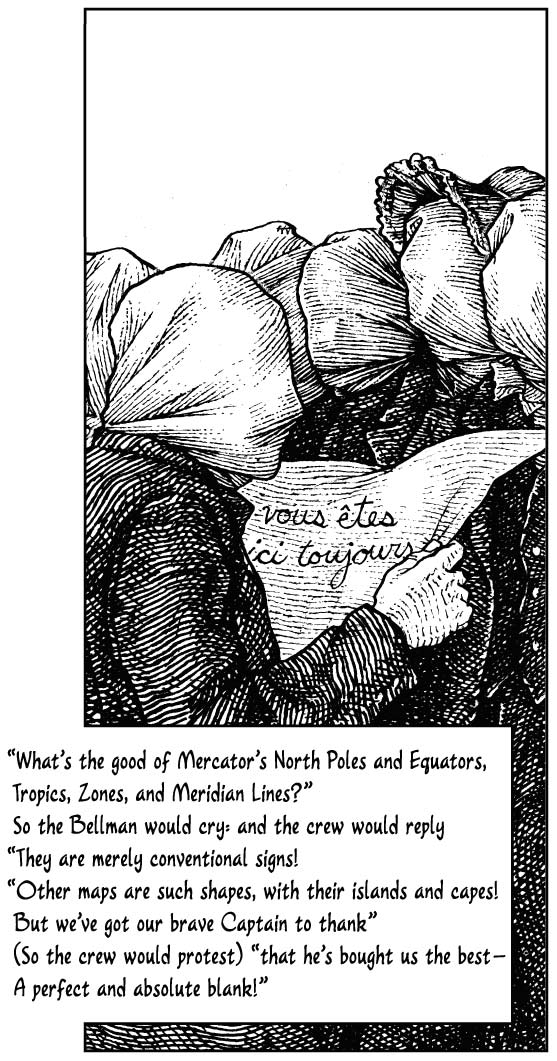
A panel from Singh's adaptation

A panel from Singh’s adaptation

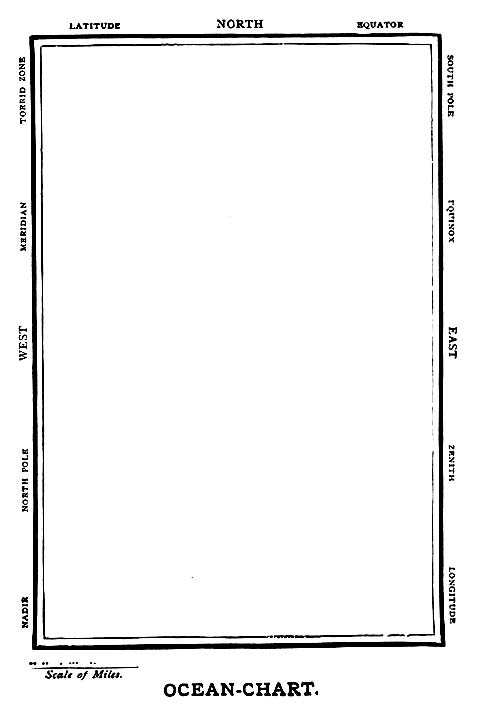
The infamous Blank Map of the Bellman is proof positive that there was no Bellwoman forcing the Bellman to stop and ask for directions. It’s also a classic example of Carroll’s subversive sense of fun in the entire Snark.

The original illustrator of the poem, Henry Holiday, simply drew a blank map for this scene, a zen-like decision which really complicated my life when I set about drawing this panel.

Outsmarting Holiday would not be easy, but I had two advantages working for me in my quest to draw that celebrated blankness. First, this was going to be the world’s first, genuinely full-scale Surrealist Snark. Second, I am a shameless borrower of things which don’t belong to me.

Both the Snark and Surrealism involve a lot horsing around with the exact meanings of words and pictures, with interchanging them, combining them, sometimes even making their entire meaning softly and silently vanish away.
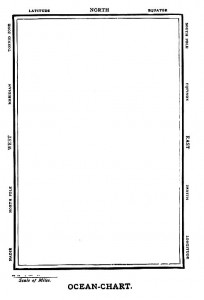
Henry Holiday’s Map of the Bellman

Henry Holiday’s Map of the Bellman

The Belgian Surrealist, Rene Magritte, was obsessed with this sort of game and his painting, “The Lover”, makes a perfect comment upon the Bellman’s Map. So, I just took it. Shameless on my part, yes, but there’s even more of that to come.

The map’s legend, “you are here” is literally true but what’s really shameless is my insistence that French is the language of the lost and confused when everyone knows that it’s really English. This is easily verified. Stand on a street corner in any big francophone city and ask a stranger: where am I? If necessary, pull at shirtsleeves and wave your arms, speak very slowly while carefully pronouncing every word at the utmost decibel level. I think you’ll quickly see what I mean.

Words, words, words! If only they had the decency to cover themselves up, like the Bellman & Company. They have no loyalty, they can’t be bothered to mean anything anymore, they’re shameless!

Rene Magritte’s “The Lovers”

Rene Magritte’s “The Lovers”

Singh’s Snark is for sale on Amazon here, and more on The Hunting of the Snark around our website here.
Share

26 Portmanteaus in a new book

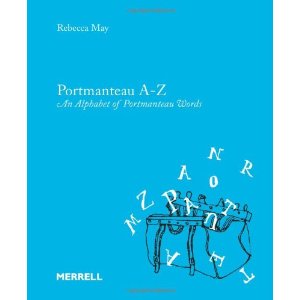
There’s a new book celebrating the art of combining two words into a new word: Portmanteau A-Z: An Alphabet of Portmanteau Words by Rebecca May (Merrell Publishers, $14.95.) It’s hardly encyclopedic, she only chooses 26 words. But Lewis Carroll is credited and discussed in the introduction, and Jabberwocky is quoted at the beginning. Among the words she chooses are galumph, uffish, mimsy, Frankenfood, Oxbridge, ruckus (a blend of “ruction” and “rumpus!” I never knew!) and stumblesharf.

Share

Atomic Antelope’s Alice iPad e-book not boring according to the NY Times

There’s an article by Alice Rawsthorn in the Nov. 28th New York Times to complain about how “boring” the design for most of the new apps for the iPad have been: “On an Innovative Device, Apps Lacking Imagination.”

However! Atomic Antelope’s beautiful and creative Alice’s Adventure’s in Wonderland popup e-book is singled out as one of her “honorable exceptions,” along with a few magazine apps like The New Yorker and Wired.

As for books, children’s titles are leading the way with apps that include animated illustrations, often activated by the reader. My favorites are the fabulously surreal ones in “Alice for the iPad,” Atomic Antelope’s interactive version of Lewis Carroll’s “Alice in Wonderland,” and Oceanhouse Media’s “Dr. Seuss” apps. Kids can “play” the Dr. Seuss stories like movies — saving you from reading the same one again and again. Each word is highlighted when it is spoken on the soundtrack.

There has been less experimentation for grown-ups. Though the British publishing house Fourth Estate has produced an intriguing app based on the mathematician Marcus du Sautoy’s book “The Num8er My5teries.” Rather than replicate the book, it complements it by enabling the reader to participate in animated mathematical puzzles featuring a cartoon version of Mr. Sautoy.

Share