Recently, the Dutch Lewis Carroll Genootschap (Society) reviewed the LCSNA’s latest book, Lewis Carroll and Alice on Stage: The Savile Clarke Letters by Clare Imholtz! The in-depth and effusive review was written by Henk van Vliegen and published in the Genootschap’s journal Phlizz, and they’ve generously allowed us to post it in its entirety here. Many thanks to our sister society in the Netherlands for their permission, and to Dr. Gerard T. Moran for the English translation.
Review of Lewis Carroll and Alice on Stage: The Savile Clarke Letters
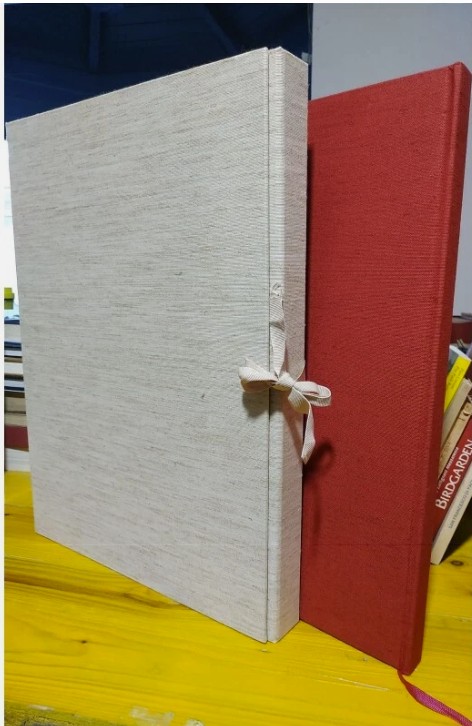
Under the cloth dust jacket with red letters is a red bound book with as dedication the print (voorplat) of John Tenniel’s White Rabbit. We encounter that red, both first editions of the Alice books were in red, regularly in the layout of this beautiful book. On the flyleaves and also on the pages with the letters, the notes are printed in red (see p. 56/7) as are the letters of the alphabet in the index and the page numbers on the list of illustrations.
Opposite the title page there is a splendid photo of Phoebe Carlo as Alice. The core of the books consists of 103 letters from Charles Dodgson to the playwright, journalist and critic Henry Savile Clarke, who made a successful play of out of both Alice books. The first series runs from December 1886 to August 1887 in the Prince of Wales’s theatre in London followed by a regional tour; the revival from the end of December 1888 until the beginning of February was only in the Globe Theater in London.
Prologue
The book begins with a real surprise: a posthumous piece , here published for the fist time, by Carroll phenomenon Morton N. Cohen “Lewis Carroll in the Wings”. Prologue is the right word for it is an homage to the initiator of this correspondence and is a piece in which the rest of the book is introduced in a pleasant way. You’re warmly prepared by Dodgson’s “intense and complex relationship with the stage” as Cohen puts it. It goes back to 22 June 1855 when Dodgson was 23 and had just got his Bachelor of Arts. He saw Shakespeare’s Henry VIII and was hooked.
Cohen examines the relationship from four points of view.
The first was his relation as theatergoer. He saw everything that was staged in Oxford and went to theaters in London with some regularity. He developed a definite preference for certain genres, actors and authors with a definite taste for the conventional, traditional sort. He gladly frequented circles of producers, authors and actors, among them child stars, and took family and friends to performances. All the more surprising since the church was skeptical of the theater.
One of Dodgson’s key aspects was a holy fear of grossness (sexual) vulgarities or religious satire. For that reason he could leave a performance or got mad when he saw a good pantomime that was ruined by a closing clownish piece with vulgar elements.
The second point was Dodgson as playwright. He certainly was not one and knew it
The third point as author who wanted to see his Alice books produced as plays. Within a year of publication of the Wonderland book he had started thinking of adapting them for the stage even seeking the advice of professionals. But nothing happened for years though he had registered them as drama so he could retain the copyright.
It was only in 1886 that the business picked up with Henry Savile Clarke, an experienced playwright. He wrote to Dodgson with a request to stage the books. Dodgson answered in the affirmative but on condition that the plays contain no “coarseness”, no vulgarity. The “dream play”, as it was called in a poster, premiered at Christmas time on 23 December 1886. There followed 70 performances in London and a regional tour. Dodgson saw the play only a week after the premiere. The play received positive reviews (Cohen doesn’t pay any attention to the negative ones) and the revival two years later got even better ones, though much fewer in number. The Savile Clarke adaption remained long in use. Imholtz cites a poster from 1906 used for a performance from around 1934.
The fourth point was Dodgson as theoretician of the theater. Many articles. Although he was a faithful churchgoer and conservative Dodgson was crazy about theater. He certainly realized the dangers: loose morals and a messy environment, but considered the stage an important social force, good for the elevation of the intellect as long as properly applied. He gave his “salary” for the second series to Savile Clarke, often saw to it that child actors remained in school, supported them at times financially or saw to possibilities for attending theater school. He opposed the law that prohibited children under 10 from becoming actors. It gave them pleasure but also was often important as a supplement to family income.
Introduction
Imholtz’s use of Cohen’s text as prologue is a good move, the audience continually experiences pleasure reading the letters. Cohen asked Imholtz to publish and annotate those letters definitely addressed to one person or theme, in which a lot is made clear about Dodgson’s personality and the two Alice books. Unfortunately, Clarke’s letters have not survived. We therefore have to surmise their content from Carroll’s (Dodgson) answer, but Clarke frequently didn’t react.
Dodgson starts out as said, somewhat on the offensive: no coarseness and vulgarities and he sticks to that. He defends some preferences with verve, for example, that only one of the books be used, but in fact he is always lenient and gradually more indulgent. Nonetheless he is not adverse to peppering Clarke continuously, also during the revival, with proposals, complaints, and improvements.
The two finally meet each other on the 29th of March just before the provincial tour started. Despite their differences of opinion they maintained a friendly relationship.
Dodson wanted to make his authorship (as Lewis Carroll) clear and wrote in the periodical The Theatre about the performance. On 1 April 1887 his, since well known piece “Alice on the Stage”, appears. Imholtz prints the text as an appendix. Carroll wrote a friendly article about the performance, even though he had definite criticisms, as we know from his diary and letters to friends. He had steadily less desire to see the play.
At the revival Dodgson again had all kinds of objections. The revival’s run time was shortened, decided on 9 February 1889. Dodgson thought this had to do with low attendance figures but that wasn’t the case. It probably was due to the use of child actors who were too young and also that the theatre manager had planned another production.
Dodgson himself introduced the two actresses playing Alice. He further favored involving a couple of experienced adult actors to improve the quality. Clarke chose the composer. In terms of finances Dodgson generosity is striking. He thought that he himself got little, but that was not a point. But he objected to the fact that the theater manager got too much and Clarke relatively little. He donated his proceeds to Clarke for the second series, after all he had no children to feed.
In contrast to Cohen, Imholtz discusses, in addition to the positive reviews, some negative ones (one even spoke about the “ ….possibility of giving the children their first real experience of boredom”). Some reviews delve into actors, music, decor and costumes so that we come to know quite a bit. For the rest we have the libretto that at almost all performances was for sale, (the few times it was not Dodgson was angry).
Imholtz devotes a special part of the introduction to Clake’s three daughters. Some remarks in the letters recall the rumors of Dodgson’s rather sticky conduct with his female child friends. He whines about kissing/kissability of the Clarke’s children” (who were 14, 16 and 17 at the time). And he’s insulted when a girl ends a letter not with “love”, but with “friendly greetings”.
Then follow Sources and an explanation of the editorial principles. All letters are reproduced in full. The extensive notes are based above all on Dodgson’s diaries and letters to family and friends. There are of course other sources such as the British Newspaper Archive. The name Lewis Carroll is used to denote the author, otherwise Imholtz uses Charles Dodgson exclusively.
Armed with the knowledge provided in the Prologue and Introduction the letters are crystal clear.
Letters and Notes pp. 53-249 30-8-1886 –30-5-1892
(with a gap between 5-11 1887 and 28 -4-1888, then it continues about the revival)
….but the only essential condition that I should have your written guarantee , that neither in the libretto nor in any of the stage business , shall any coarseness, or anything suggestive of coarseness be admitted” (Dodgson, 30-8-1886)
“There is one & only one condition…” as Dodgson squarely begins in answer to Savile Clarke’s question whether he can produce Alice for the stage. It is the start of a very interesting exchange of letters with one of the things that mattered most to Dodgson, in this correspondence as well. Dodgson attends a performance of the revival with two extraordinarily vulgar moments, one in which the White King falls over backwards with legs akimbo. He threatens to withdraw his approval and Clarke revises immediately.
There are more recurring matters that start in this letter. Dodgson wants namely that just one book be used but finally agrees that both Alice books are used but not mixed together. And that takes place: Wonderland comes before the intermission and Through the Looking Glass after.
Wherever possible he wants the original tunes of the Alice parodies used.
Dodgson bombards Clarke with instructions, proposals and suggestions. When the performances incorporate new ideas , he complains about things such as the Queens’ awful diction, scenes that don’t work or missing librettos. After a few weeks of the first series he even wants to stop the production. He introduces such desires and complaints with a resounding understatement such as: “a few other matters…”
Clarke barely reacts to all these lists of wishes and criticisms, but both think the scene of the Walrus and the Carpenter poor. It is replaced with a nice revision: the addition of three oyster ghosts, one of whom dances and sings a hornpipe, which is a great success. On 24 September 1886 you read the first of many invitations from Dodgson to Clarke to visit him, which never happens but Dodgson does visit Clarke later when he’s in London. There are interesting items about Dodgson’s suggestions as actors. Both Alices, Phoebe Carlo and Isa Bowman were proposed by Dodgson. With Bowman, Dodgson does his extra best in a couple of letters to get her selected, undoubtedly under her influence. For the second series he really wants Irene Vanburgh as Queen of Hearts and White Queen, which succeeds, but not to get her picked in the opening scene as Fairy Queen. Clarke doesn’t add this character. A real treat is the exposé, for which Dodgson takes the time on 17 September 1886, in which he writes of the possibility of special type of theater for children. He theorizes about writers and all kinds of books that would be suitable but also about the building itself, preferably small which would lead to it being sold out more often. And that would be good for the idea, just imagine!
Just as nice are Dodgson’s reflections in a letter dated 12-2-1889, as the series closes, about having an Alice in Wonderland every Christmas, but then such as he would have wished it, with new elements and fresh new songs, so that you can keep going anew!
There are also letters in which financial matters dominate. Dodgson is especially unhappy with the conduct and compensation of the managers, especially compared to the amount Clarke earns on the production. Time after time Dodgson tries to get an answer to the question whether a book can be published with music from the production. It was not to come in his lifetime. Just as to the question whether photos and especially Alice books could be sold in the Globe Theater. As a true marketing man he has it planned out but when it finally happens it was so badly produced that only 5 copies of this so-called People’s Editions were sold. With the revival Dodgson complained a couple of times that you even had to pay for the program.
Imholtz’s footnotes
Imholtz’s notes are careful and generous without sinning by providing too much information. She even manages to summarize whole research projects in the notes. She lucidly explains the difference between a pantomime and a harlequinade. The extensiveness only rarely feels unnecessary, for example, when researching addresses of child actors who received a book from Carroll as memento of their participation. It is also unnecessary to repeat twice the explanation of “affty” (affectionately) ( notes 192, 194, 229).
Here and there she allows herself a joke: “unsurprisingly, Dodgson did not hesitate to jump in with {advice} advise (sic). In note 200 she reacts to Dodgson’s affected attempt to portray Isa as pitiful. She is very much afraid that the revival will be canceled because no venue is available. Imholtz: “Dodgson is Isa’s White Knight.”
She treats Dodgson in any case critically. A letter of 7-11-1887 to Kitty Clarke (according to Imholtz) begins “Dear Child . Imholtz notes ironically “aged fifteen”. On 25-12-1889 Dodgson complains that Isa is not named in advertisements. Imholtz wonders whether Isa at that point in her career could serve to attract an audience.
Appendices
After the letters there are several appendices altogether more than 100 pages! North Americans are crazy about appendices in their scholarly literature. You of course don’t have to read an appendix but it is often full of interesting facts and even theoretical underpinnings.
Appendix A: Crustacean Mutations (“Schaalderige Veranderingen ») concerns the transformations through time of the parody of “Tis the voice of the lobster” from Chapter 10 of Wonderland. Imholtz reconstructs these changes, a reconstruction that is completely at home here because it is partially due to the idea that Clarke had to expand the song for the stage performance. Naturally you could skip this appendix, thinking “nonsense” but all the same it is a stirring bit of history and funny here and there as well.
Appendix B, about Dodgson and Alice on the stage overlaps a bit with the Prologue, which also began with the observation that Dodgson had early on weighed the possibility of adapting Alice for the stage (an adaptation that would not be a drama, pantomime, entertainment, magic lantern show, extravaganza or portrait (tableau). And also the question of whether Dodgson himself could be the playwright. But Cohen in working it out began with the contacts between Dodgson and Savile Clarke and their result, which is appropriate, because, after all, that is what the book is about.
In this appendix Imholtz describes multiple earlier attempts by Dodgson to get Alice adapted to the stage, for example, to find a composer for the songs and such. Humorous is the description of Dodgson, also by others, when he again saw a girl who could play Alice, he saw potential Alices everywhere! Imholtz also cites numerous other adaptions of (scenes from) Alice from before and after Clarke.
This is interesting as well because it deals with 19th century notions of copyright, a rather arcane matter. Dodgson had registered his two Alice books as drama, but that only meant that he had the copyright on a possible performance of his text. Everyone who adapted Alice obtained the copyright of their own version. The author therefore earned nothing. Still adapters thought it interesting to have Dodgson’s approval of their version, which he at times granted but at others not.
Appendix C as well: “Savile Clarke’s Alice , Charles Dodgson and the Child Acting Controversy” adds something to the correspondence. It treats the issue, which is nicely summarized, whether children under 10 years of age can be used as theater actors. A law on this issue was pending. Dodgson and Clarke strongly opposed the law although they were aware as well of the negative aspects of the practice.
Appendix D:” Henry Saville Clarke”, see the photo included in the book, covers the playwright/director, journalist and critic Clarke and his family. It had of course to be so. Clarke is a main character, but also because Dodgson describes his relationship with the Clarke “children”.
Appendix E will be a familiar text for experts. It is “Alice on the Stage” written by Dodgson himself using the pseudonym Lewis Carroll, a text which can be found in many places but is entirely germane here. Carroll identifies himself as author of the Alice stories and reacts with complete approval to the stage version.
After the bibliography, the acknowledgments and index, is a page of information about LSCNA, which is natural as it is the publisher of this book and an active Carroll society.
In Conclusion
All things considered a very successful book. It includes well-known matters but they are here set nicely in relation to each other. Furthermore, the reader is regularly treated to surprises such as the Prologue and letters in which Dodgson takes his time to work something out. Given that all the letters are included it is unavoidable that less interesting things appear for example concerning appointments, passing on things and other trivial matters. But so be it. It is part of the contact between the central figures.
Is it so that by reading these letters you get the essence of Dodgson/Carroll? In any case you come a long way.
You read about his endless energy to hold on to control, about his constant aim to attack everything vulgar, coarse, and blasphemous, to keep the name Dodgson separate from his pseudonym, about how he approaches “kissable” girls, often not children anymore, and their parents, about his hobbies and his many contacts, and even about what his house looks like and what he has for lunch. You also get to know about Dodgson’s relationship to books. If he doesn’t like a edition (oplage), whether it’s print run is high or low, he rejects it. He regularly makes special bindings for his books to give them as presents. And we even see him as puzzle maker. On 14 January 1887 he includes a task for Clarke’s children: a doublet (?) (a puzzle he thought up): “From Alice to sleep.”
In passing you also get a good idea of just how active and busy Savile Clarke was.
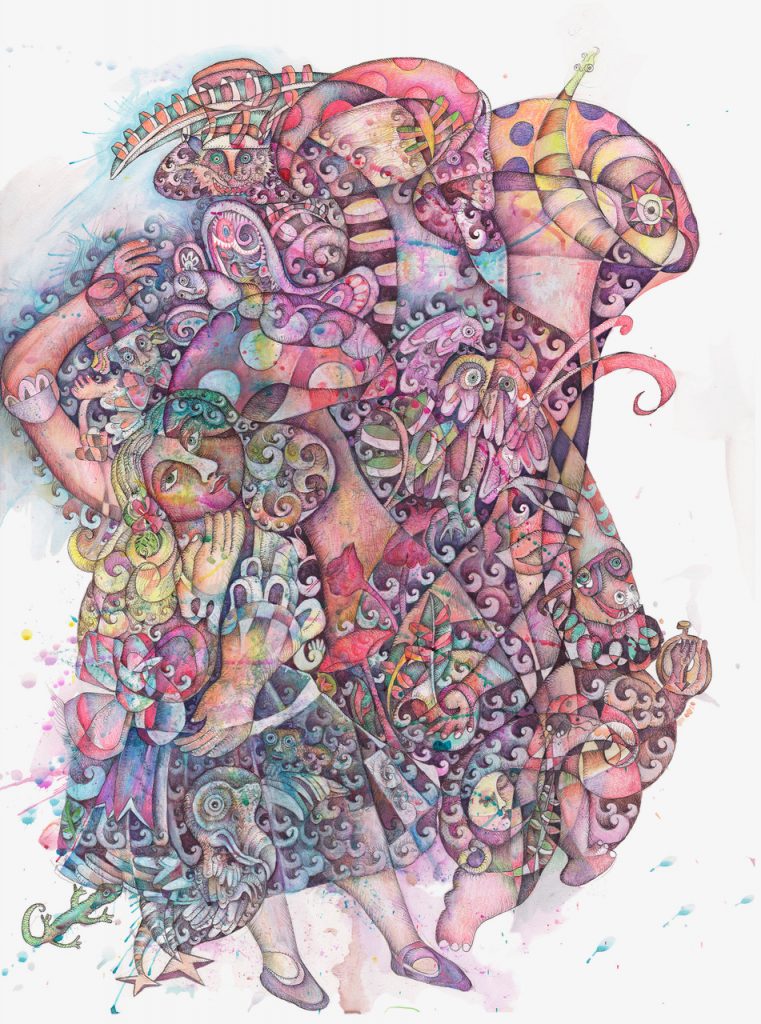
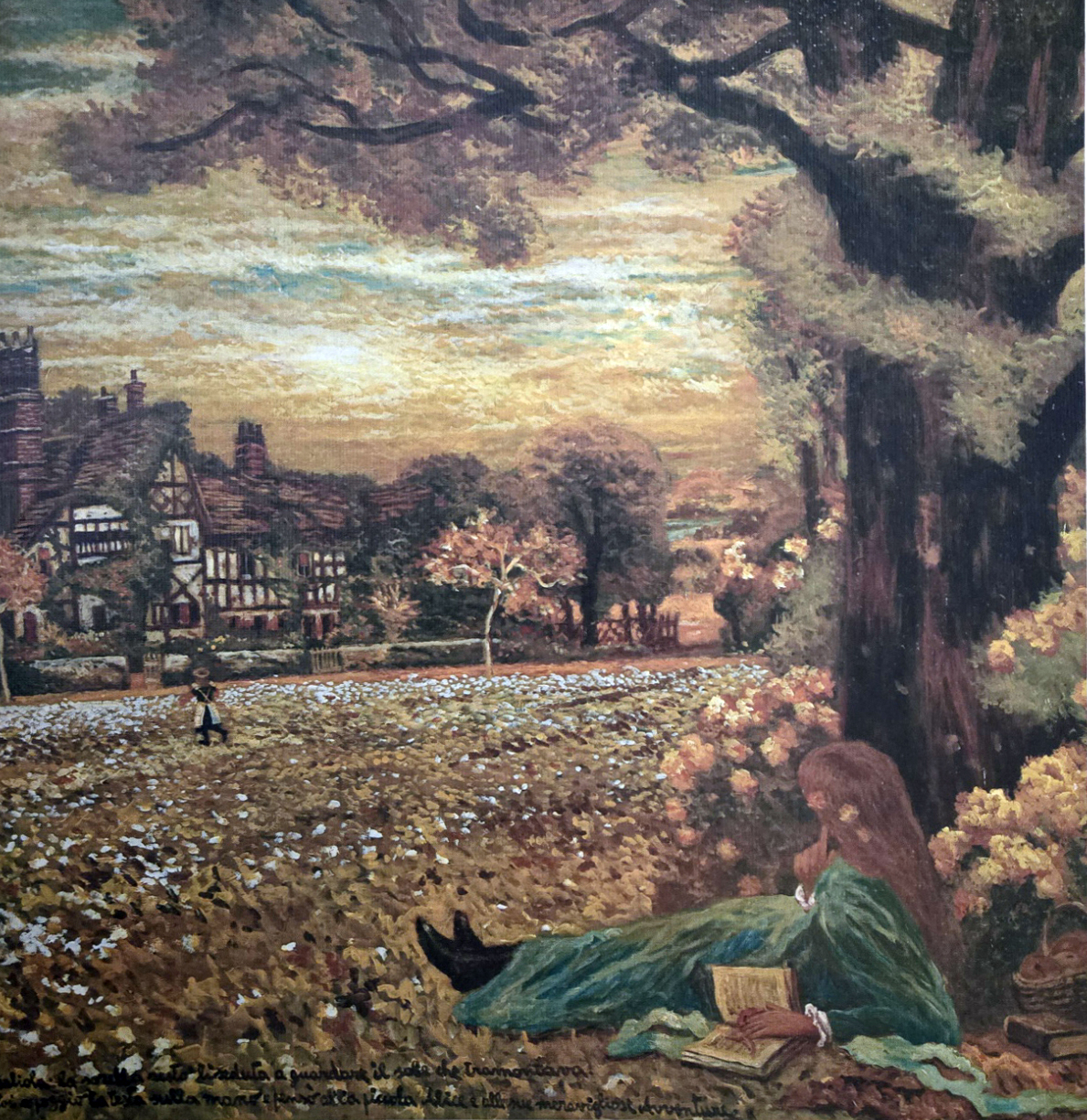
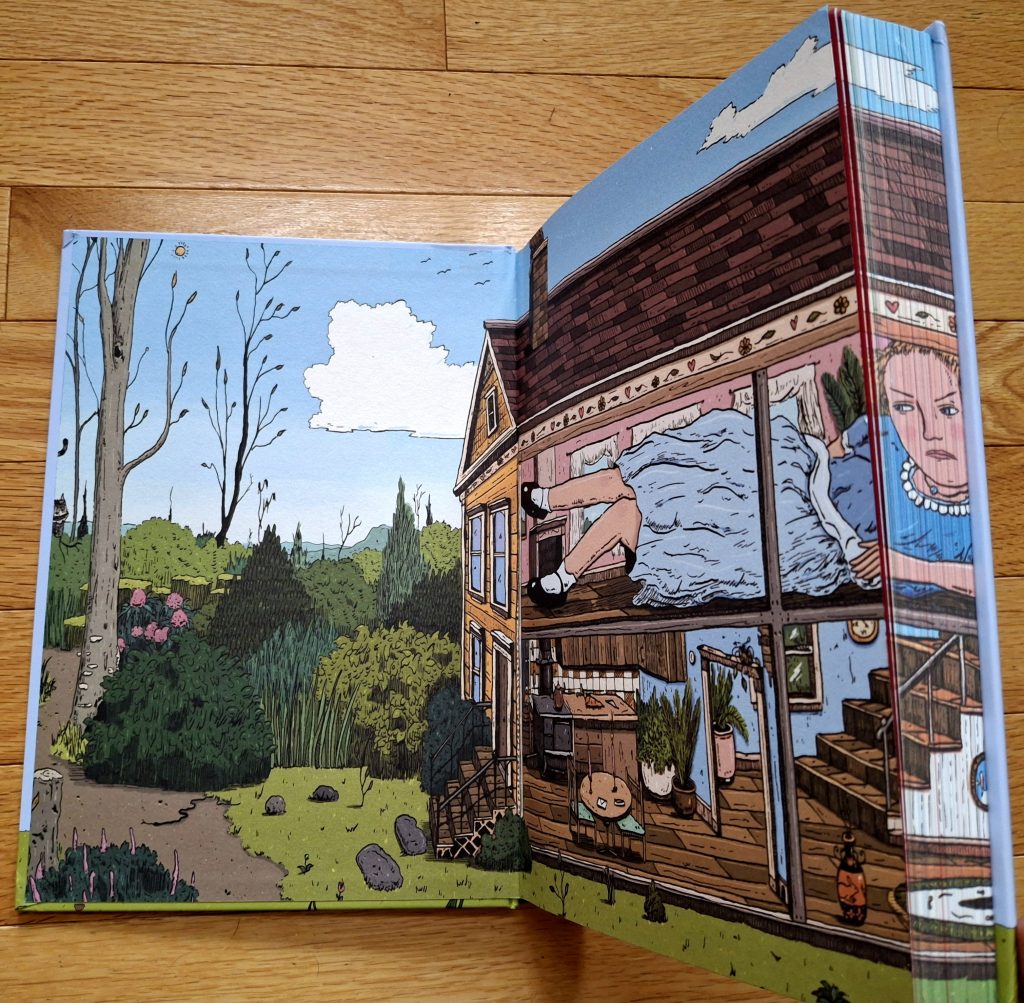
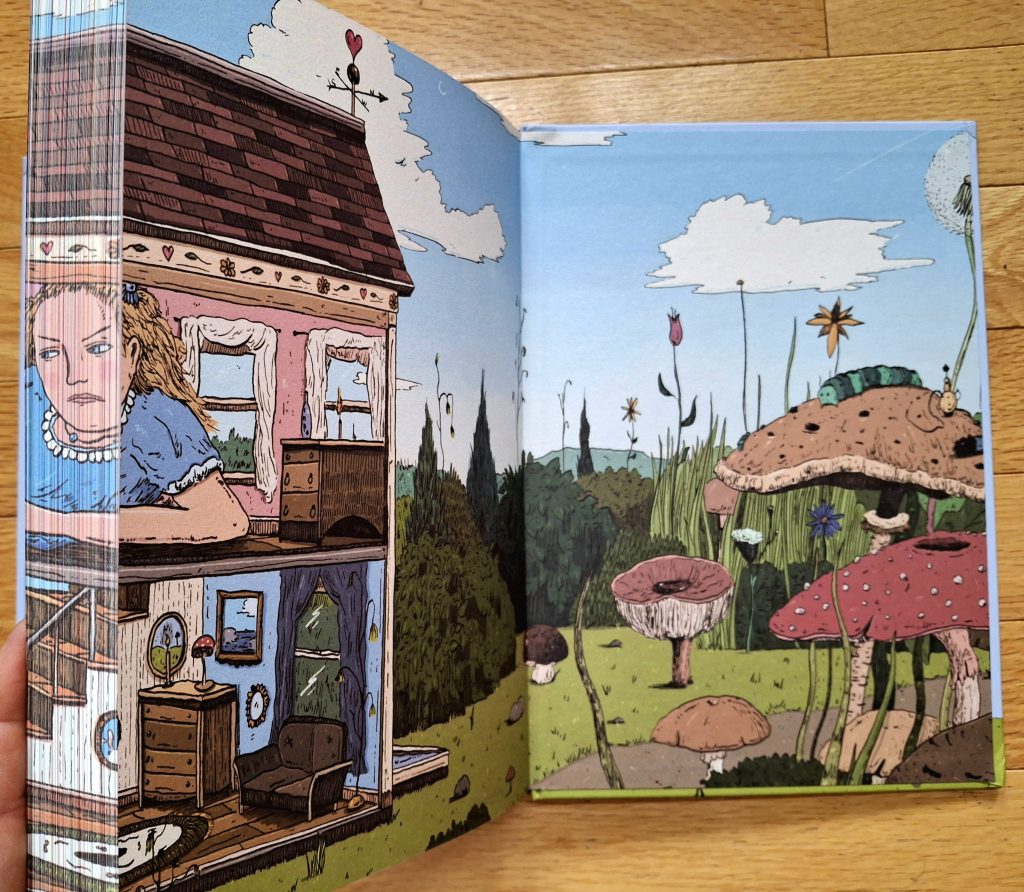
The book features a couple of special illustrations, among others of the actors. Beneath you see an illustration with in its center a drawing by Ellen Whiehead, parts of which are also visible in the red fly leaves.
By Henk van Vliegen 1 January 2026.
Translated from the Dutch by Dr. Gerard T. Moran 11 February 2026
Online magazine of the [Dutch] Lewis Carroll Society
Review of Lewis Carroll and Alice on Stage: The Savile Clarke Letters.
Author/editor Clare Imholtz
Publisher: Lewis Carroll Society of North America
Distributor: University of Virginia Press, Charlottesville & London, 2025, 355 p.
ISBN 9780930326180