The Blog of the LCSNA

Burbles

Page 96 of 121

The Blog of the LCSNA

Just the day to see Alice in Wonderland… (1903)

At 12.01am this morning the curtain rose on Tim Burton’s Alice in Wonderland. If the last five months of hype have left you cold, how about being truly perverse and making today the day you watched the first Alice movie ever made?

Alice in Wonderand (1903), carefully restored by the British Film Institute’s National Archive, is now available online. In fact you can watch it right now, right here:

A fascinating article about the restoration project appears on the British Film Institute’s website. Apparently, the film featured the first British actor ever to be named in the credits of a film: it was the collie dog glimpsed at 3:16 minutes in, later to star in Rescued by Rover (1905). Now you know.

From the March 5th – 15th, the BFI will be hosting a “brief rabbit-hole retro,” with a selection of the most notable Alice films, from Paramount’s 1933 star-studded oddity, through to Jan Svankmajer’s 1988 masterpiece of taxidermy. All films will be shown at the London Southbank Centre. For a full schedule and ticket information, see the BFI website.

Share

Criticizing the Critics, & futterwacking around the Alice Movie Paradox

[Warning! Spoiler alert! It was all a dream!]

When Lewis Carroll published a few thousand copies of Alice’s Adventures in Wonderland in 1865, with no hype or buzz, it received some mixed reviews. That’s one of the few things Tim Burton’s Alice in Wonderland has in common with Carroll’s original stories. The critics were out this week, and occasionally perceptive. As of this morning, the “top critics” that Rotten Tomatoes tracks average at about 59% (between rotten tomato and ripe tomato), with the general masses giving it about 53%. Manohla Dargis of the New York Times, one of my favorite critics to disagree with, had some interesting insight into the Alice Paradox in movies:

Dark and sometimes grim, this isn’t your great-grandmother’s Alice or that of Uncle Walt, who was disappointed with the 1951 Disney version of “Alice in Wonderland.” “Alice has no character,” said a writer who worked on that project. “She merely plays straight man to a cast of screwball comics.” Of course the character of Carroll’s original Alice is evident in each outrageous creation she dreams up in “Wonderland” and in the sequel, “Through the Looking-Glass,” which means that she’s a straight man to her own imagination. (She is Wonderland.) Here she mostly serves as a foil for the top biller Johnny Depp, who (yes, yes) plays the Mad Hatter, and Mr. Burton’s bright and leaden whimsies.

Her conclusion, however, is vague and baffling:

This isn’t an impossible story to translate to the screen, as the Czech filmmaker Jan Svankmajer showed with “Alice” (1988), where the divide between reality and fantasy blurs as it does in dreams. It’s just hard to know why Mr. Burton, who doesn’t seem much interested in Alice, bothered.

The great Roger Ebert, at the Chicago Sun-Times, admits he didn’t care for the books growing up, which possibly explains some of his strange tangents:

This has never been a children’s story. There’s even a little sadism embedded in Carroll’s fantasy. It reminds me of uncles who tickle their nieces until they scream. “Alice” plays better as an adult hallucination, which is how Burton rather brilliantly interprets it until a pointless third act flies off the rails. It was a wise idea by Burton and his screenwriter, Linda Woolverton, to devise a reason that Alice (Mia Wasikowska) is now a grown girl in her late teens, revisiting a Wonderland that remains much the same, as fantasy worlds must always do.

[…]

Burton shows us Wonderland as a perturbing place where the inhabitants exist for little apparent reason other than to be peculiar and obnoxious. Do they reproduce? Most species seem to have only one member, as if nature quit while she was ahead.

How could he not develop that shocking exposée? Who was the Duchess’s baby daddy? Is there a Mrs. Mock Turtle!? I wish Carroll was around to explain the laws of dream procreation.

One more quote, I’ll give Elizabeth Weizman of New York Daily News my highly coveted Saying Nothing Award:

“Frabjous” may be a word Carroll invented, but Burton knows just what it means, at least in his own mind. He’s clearly excited to invite us inside, and as long as you’re open to so much muchness, you’ll be very glad he did.

This parsing of critics possibly to be continued… In the meantime, I have several questions:

-How come no one has discussed the influence of Miranda Richardson’s Queen Elizabeth I from BBC’s “Blackadder II” (1986) on Helena Bonham Carter’s Red Queen?

-Why was the Dodgson-esque figure named Charles at the beginning Alice’s dead father? What?

-Did the bizarre Chinese trade-route plot-line at the finale, which was guided on by the blue butterfly (née Caterpillar), have anything to do with opium (i.e., the possible contents of the Caterpillar’s pipe)? I know it was 2am and I had a headache from two hours of drinking wine in an IMAX with 3D glasses, but I think I may be onto a possible explanation for the otherwise unexplainable China thing.

Share

Alice Around Town

The New York website Woman Around Town has a series of articles about Alice this week, two quoting Lewis Carroll Society of North America president Andrew Sellon. From Charlene Giannetti’s obligatory round-up of Alice movies, “Lewis Carroll’s Alice—A Favorite for Film Makers”:

When Tim Burton’s Alice in Wonderland opens on Friday, March 5, the film will join many others that have sought to bring Lewis Carroll’s tales to the screen. “In terms of adapting [these books], it’s tricky,” says Andrew Sellon, President, Lewis Carroll Society of North America. “As written, they are not right for the medium.” Sellon explains that Carroll’s characters don’t encounter enough conflict to create the action necessary for a production on stage or in a film.

And from the same author’s “Alice in Wonderland—Timeless as the White Rabbit’s Watch”, which delves deeper into artistic and cultural influence:

The visual imagery as well as a cast of quirky, colorful characters, makes Alice’s story an attractive takeoff point for artists. The basic story is a familiar one: a young girl is lost far away from home and must find her way back. Along the way, Alice, like Dorothy in the Wizard of Oz, meets some interesting personalities, uses her wits to survive, and, in the process, learns a lot about herself and what she holds dear. There’s a timelessness to that story that continues to draw people in, generation after generation.”This child enters these adult realms and sees adults behaving badly, handles herself quite well, and gains some measure of control over her life,” says Andrew Sellon, President, the Lewis Carroll Society of North America. “At some time we’ve all felt like Alice. What is this place we’re in and why are people doing this and who is making the rules? You can apply that almost anywhere.”

Mark Richards, Chairman of the Lewis Carroll Society, agrees. “Although it is easy to see [Alice in Wonderland] as a Victorian story, the conversations and characters are timeless and we can easily see them as being of our own time.” Richards adds that people are captivated by “the way in which Alice observes her surroundings and feels emotions throughout the book. The sense of wonder is very strong in the books and is felt by the reader.”

It continues with Sellon’s observations about reading the book to children and the perennial drug question.

Share

AudioFile Magazine presents a Listeners’ Guide to Alice In Wonderland and Free Audiobook Download


AudioFile, the magazine and website devoted to audiobooks, has announced that for two weeks only it is going “mad about Alice!” – a remarkable instance of infectious disease control and an example to Hollywood.

In its madness, Audiofile is offering a free download of Alice’s Adventures in Wonderland, as narrated by Michael York, courtesy of Blackstone Audio.

This download is only part of an Audiofile Listeners’ Guide to Alice in Wonderland, “an online multimedia event where visitors can listen to exclusive conversations with Alice narrators, read audiobook reviews and recommendations, and discover more online resources about Alice in Wonderland.” Fans are also invited to discuss their favorite audiobook versions of Alice on AudioFile’s Facebook page.

Items in the the Listeners’ Guide include conversations with narrators Michael York and Jim Dale, and with Gabrielle de Cuir, the audio producer of York’s reading of Alice’s Adventures in Wonderland and of the recently released audiobook, Alice I Have Been.

One feature that sounds particulary interesting is “Three Mad Cups of Tea,” the Mad Tea-Party, read in turn by three different narrators. I hope some English teachers stumble across this one. The lesson plan practically writes itself.

Share

Alice’s Kitchen Sink Released on March 2nd, 2010


Paramount’s Alice in Wonderland (1933), directed by Norman Z. McLeod, has been mentioned a lot in the past few weeks, as the first big Hollywood all-star blow-out adaptation of Lewis Carroll’s books (with such stars as Cary Grant, Gary Cooper and W.C. Fields.) Slightly lost amongst the thousands of other Alices being released this month was the fact that this film, which was never released on VHS or DVD, is finally available (list price $19.99). Why is it being released as Universal Homes Entertainment? Our source from inside Paramount answers that question:

Back in 1957, Paramount sold most (but not all) of its pre-1948 film library to Universal for some quick cash (at the time, Paramount was ailing, financially). Thus, a number of Paramount films are now distributed by Universal, under their corporate and home video label […] Paramount no longer owns the rights to these films.

There’s a review from the New York Times here.
Also released on DVD on March 2nd is the SyFy miniseries Alice (list price $19.99), which originally aired last December. Jonathan Miller’s 1966 adaptation was issued on DVD (featuring John Gielgud, Peter Cook, Peter Sellers; list price $14.98). I noticed that Amazon has a deal selling all three for $38.97, the price of which won’t even get a family of three into the IMAX to see Tim Burton’s Alice in Wonderland in 3D.

There’s more: Hallmark’s “overblown” 1999 television special of Alice in Wonderland (with Whoopi Goldberg, Martin Short and Christopher Lloyd) is being reissued on DVD (list price, $19.99) along with its companion Through the Looking Glass (with Geoffrey Palmer and Ian Holm; list price only $9.98!)

Now, several tie-ins to the Disney movie were also released March 2nd: several hot new video games for Nintendo Wii (list price $39.99), Nintendo DS (list price $29.99), and a Disney Interactive computer game for PC ($19.99). The movie soundtrack by Danny Elfman was released on March 2nd (list price $18.98). And merchandise, merchandise, merchandise, too much to mention here.
Did you know Alice stories can also be purchased in a book form? Many editions of this “book” were released in conjunction with the big movie premiere, but the only book rolled out on March 2nd (to keep true to the theme of this post), was one called “The Real Alice in Wonderland: A Role Model for the Ages” by C.M. Rubin and Gabriela Rubin (list price, $29.95), from AuthorHouse. A day after it was released, it appears to already be out of stock. From the product description:

In 2006, award-winning author C.M. Rubin and her daughter, Gabriella Rubin (who are related to the Liddell family), began an incredible journey to create the ultimate book about the original Alice in Wonderland’s life. Their grand pictorial, biographic vision for the book involved collecting photographs spanning two centuries, reaching out to many celebrated Alice in Wonderland artists (including Vik Muniz, Annie Liebovitz, Mark Steele, Lizzy Rockwell, Helen Oxenbury, Frances Broomfield, Jeanne Argent, David Cooper, Bruce Fuller, Tatiana Ianovskaia, Jewel, and Tom Otterness), and connecting with museums, libraries and schools around the world. The Real Alice in Wonderland book is told using never before seen pictures along with prominent voices from Alice’s lifetime and from the present day. C.M. Rubin and her daughter Gabriella explore the theme of inspiration. Behind every great person there is the person who inspires and believes in him or her. The person who motivates them to realize their dreams. This magnificent cross-atlantic epic will fascinate you — it will make you think again: what does it mean to inspire?
The Real Alice In Wonderland book is dedicated to all those who inspire the minds and souls of human beings.

However, don’t miss Simply Read Books edition of Alice’s Adventures in Wonderland by Lewis Carroll, no longer out of print, with Iassen Ghiuselev’s unique and beautiful illustrations, reissued in hardcover on March 1st (list price, $24.95).

Share

Mad Tea Party and Guided Tours at the Rosenbach, PA

Alice considered a little, and then said, “Wash your hands. Cover your cough. Stay home if you are sick. Get vaccinated.”

Alice considered a little, and then said, "Wash your hands. Cover your cough. Stay home if you are sick. Get vaccinated."

Now that the Alice pandemic has reached the WHO-defined Phase 6, “increased and sustained transmission in general population,” the last few weeks have felt a bit like blogging through the looking-glass: it seems to take all the blogging we can do to keep in the same place. To actually inform our readers of events in advance, well, we would have to blog at least twice as fast as that.

With that excuse, it’s time for a mention of tomorrow’s Mad Tea Party at the Rosenbach Museum and Library in Philidelphia. Registration is now closed, but attendees have been promised a look at the library’s first edition of Alice’s Adventures in Wonderland, and lots and lots of tea (we hope proper saucer usage will be observed).
Over the next few weeks the library will be offering a tour of Carrollian items in their collection:

This tour will explore both the man and the author, drawing on letters from Dodgson to his publishers, original drawings by John Tenniel (the illustrator of the Alice books) photographs of children taken by Carroll, and, of course, copies of his books.

The tours promises to be “hands on,” but mind the marmalade please. LCSNA members who discover sticky fingerprints on the museum collection during the Spring Meeting on April 24th will take the matter very seriously.

Lewis Carroll/Charles Dodsgon Hands-On Tours
Rosenbach Museum and Library, Philadelphia PA

Wednesday, March 10, 2010 – 3:00pm
Sunday, March 14, 2010 – 3:00pm
Friday, March 19, 2010 – 3:00pm

Share

Around the blogosphere: Burstein’s Alice Film Roundup & Hero Complex’s Countdown

The LCSNA’s very own Mark Burstein has written a concise list of “all those awful Alice movies” (a theme that many in the media have been attempting, as reported here) for Lucas Films’ Blockbusting blog. An excerpt:

  • The groovy Sixties found a resurgence of interest in Carroll’s otherworld of mushrooms and hookah-smoking caterpillars. Hanna-Barbera’s Alice in Wonderland or What’s a Nice Kid Like You Doing in a Place Like This, voiced by Sammy Davis, Jr., Zsa Zsa Gabor, etc. was shown on television in 1966. Later that year, Alice Through the Looking Glass, a musical version with Jimmy Durante, The Smothers Brothers, etc., ran on television as well. Meanwhile, in Britain, the BBC produced a low-key, black-and-white Alice in Wonderland that is arguably the best, certainly the most faithful to the spirit, of all cinematic or televisual adaptations. It was directed by Jonathan Miller, and starred Sir John Gielgud, Peter Sellers, etc.
  • The spirit of the Sixties lasted at least until 1972, when a lavish British musical version ofWonderland starring Fiona Fullerton (later a Bond girl) as Alice, and with Spike Milligan, Peter Sellers, Dudley Moore, and so on came to the big screen.
  • A soft-core porno-slash-musical comedy Alice in Wonderland spewed forth in 1976, produced by Bill Osco, directed by Bud Townsend, and distributed by General National Enterprises. Ah, me. It’s very nearly watchable, but was the first of many subsequent erotic films “based” on the books, all of which lack even the marginal charm of this original one, and are not subject matter for this brief overview.

The whole round-up, once again, is here. Elsewhere on the blogosphere, we’ve been following the LA TimesHero Complex (which still hasn’t corrected their mistake, in their list of awful Alice movies, that the 1903 silent version was “just 68 years after Lewis Carroll first published his fantasy Alice’s Adventures in Wonderland.” Mr. Burstein prefers to note that 1903 is “just five years after Lewis Carroll (Charles Lutwidge Dodgson)’s death in 1898.”) Anyway, they are doing a daily countdown to the movie premiere, and today’s entrée is about John Tenniel:

“If you go back to Tenniel, so much of his work is what stays in your mind about Alice and about Wonderland,” Burton said. “Alice and the characters have been done so many times and in so many ways. but Tenniel’s art really lasts there in your memory.”

Tenniel was already a major name in political cartooning (and, unfortunately, blinded in one eye from a fencing wound) when he took on the illustrations for Carroll’s strange fantasy. The job was a frustrating one due to the intense detail work and specifications that came from Carroll (whose real name, by the way, was Charles Lutwidge Dodgson), but Tenniel had a passion for drawing animals, and Wonderland gave him a singular opportunity for creatures of the fantastic. Tenniel was also a meticulous soul and a demanding artist — the first run of 2,000 copies of “Alice” in 1865, for instance, did not meet his standards and were pulled back. The project was well worth the trouble, however, when the book became an instant literary sensation.

It’s nice of them to quote Burton discussing Tenniel, because, earlier when they had quoted him discussing his Red Queen’s huge head, it struck me as odd that he didn’t acknowledge Tenniel as the origin of that phenomenon. (“In lots of illustrations and incarnations of Carroll’s work through the years, it always seems like she had a big head,” he noted vaguely.)
Share

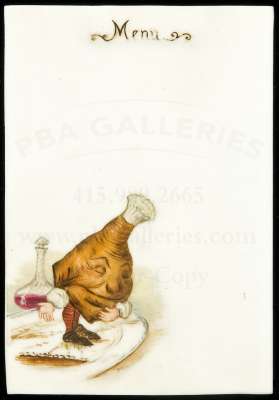
Tenniel family menu cards up for auction

Menu cards  (porcelain plaques), created by John Tenniel for family dinners, based on his illustrations for Lewis Carroll’s Alice books, are up for auction at PBA Galleries (133 Kearny St, San Francisco) – low estimate $20k, high estimate $30k. The product description from their website:

Six small hand-painted porcelain plaques by John Tenniel, each with its own wrought-iron miniature easel. Each has a character from Alice’s Adventures in Wonderland or Through the Looking-Glass taking up about a quarter of the plaque, with the remainder blank, and “Menu” written at the top of each. The plaques measure 5×3½; the easels are about 7½” high.

Marvelous and unique group of original hand-painted plaques used as menu cards for the Tenniel family dinners, descended in the family over the years. The night’s fare was evidently written in the blank spaces with a crayon or grease pencil, then wiped off after the meal was completed. The characters pictured are The White Rabbit (with his pocket-watch), the Mock Turtle (crying away), the Frog Footman (delivering a letter), the Walrus (without the Oysters and the Carpenter), the Leg of Mutton (taking a bow), and a frog with a rake. The plaques have a small wooden case with a removable top, on which is a label with writing “China (Delicate)”. The case top has two sides missing, some other wear.
Share

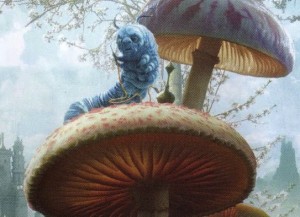
Rated PG for Hookah-Smoking Caterpillar

I just noticed that Tim Burton’s Alice In Wonderland is rated PG “for fantasy action/violence involving scary images and situations, and for a smoking caterpillar.” Wonderful! Disney’s 1951 version, which also contains a smoking caterpillar, is rated simply G. Therefore, since All Scotchmen are Non-Dragons, and a fish with three rows of teeth is not to be despised, it would follow that it was not that hookah-smoking caterpillar which increased the rating from G to PG.

Smoking in movies is of course a contentious issue, with many organizations and websites tracking Hollywood for how it portrays tobacco use. (There’s something called the “Hackademy Awards”, presented by the Breathe California of Sacramento-Emigrant Trails, for smoke-free movies. Nine, for instance, got last year’s biggest Thumbs Down for “lavishly promoting cigarette and cigar smoking as emblems of sexiness, wealth, power, coolness and relaxation.”) Shisha is not something they come across very often, so I’m curious to see how this goes down.

Alan Rickman (the great actor famous for his Professor Severus Snape) is playing the voice of the Caterpillar in the new film!

Share

“Alice’s Theme”: Music & Lyrics by Danny Elfman

Danny Elfman’s soundtrack to Tim Burton’s Alice In Wonderland will be released on CD (an ancient kind of optical disc used to store digital audio) next Tuesday, March 2nd, and there’s some short clips at the Amazon store if you desire a teaser. I couldn’t help noticing the opening song – with children’s voices singing “Oh, Alice, dear where have you been?” – and I found the complete lyrics at a blog called cinemusic.net. I’ll include them with that website’s charming introduction:

Tim Burton’s Alice in Wonderland, starring Johnny Depp as Elijah Wood The Mad Hatter begins pissing off prickly Lewis Carroll purists on March 5, 2010 in theaters everywhere in eye-popping 3D. Lending musical support is Burton’s constant composer Danny Elfman, AKA film music’s most awesome red head.

Threaded throughout the score is an original song penned by Elfman, called “Alice’s Theme”, and it opens up the Disney Records score album due in stores on March 2 (obligatory Amazon link). Here’s a sneak peek at the song’s lyrics (thanks to the supremely talented LD for these)…

Danny Elfman Soundtrack

“Alice’s Theme”
Music and Lyrics by Danny Elfman

Oh, Alice, dear where have you been?
So near, so far or in between?
What have you heard what have you seen?
Alice, Alice, please, Alice!

Oh, tell us are you big or small
To try this one or try them all
It’s such a long, long way to fall
Alice, Alice, oh, Alice

How can you know this way not that?
You choose the door you choose the path
Perhaps you should be coming back
Another day, another day

And nothing is quite what is seems
You’re dreaming are you dreaming, oh, Alice?
(Oh, how will you find your way? Oh, how will you find your way?)
(There’s not time for tears today. There’s no time for tears today.)

So many doors – how did you choose
So much to gain so much to lose
So many things got in your way
No time today, no time today
Be careful not to lose your head
Just think of what the doormouse [sic] said…Alice!

Did someone pull you by the hand?
How many miles to Wonderland?
Please tell us so we’ll understand
Alice…Alice…Oh, Alice

(Oh how will you find you way? … Oh, how will you find you way?)

Sing along!

I’ve never met a prickly Lewis Carroll purist, let alone a pissed-off one, but I would presume they’re easily decapitated with a vorpal sword. Or defenestrated with a defibrillator.

Anyway, if you are not familiar with Mr. Elfman, he is the film composer and long-time collaborator with Mr. Burton, the man wrote the iconic music for Batman, The Simpsons theme, and those wonderful songs for The Nightmare Before Christmas. He has done less-than-stellar work for some of Mr. Burton’s more recent mediocrities. Elfman is often mocked in the classical world for basically having a team of composers do his work for him, although I sometimes feel this criticism is harsh. (After all, Renaissance painters employed whole crews of apprentices, Dale Chihuly has a studio to manifest his glass-art masterpieces, and George Gershwin didn’t do the orchestrations for Rhapsody in Blue (free round of drinks if you can name the composer who did!) Art is not always the product of an agonized solo genius, sometimes she can be more of an architectural designer, et cetera, especially in the film music world. Thus ends this parenthetical rant.)

As dear to my adolescent heart as Elfman’s music for The Nightmare Before Christmas is, there’s many cringeworthy lyrics (e.g., “I wish my cohorts weren’t so dumb / I’m not the dumb one / You’re no fun / Shut up! / Make me!”) I would pay a large sum of money to hire William Shatner to read the lyrics to “Alice’s Theme” as a beat poem accompanied by bongos and upright bass (as he did for Sarah Palin’s verbiage). In conclusion, Mr. Elfman should hire a real librettist.

Share