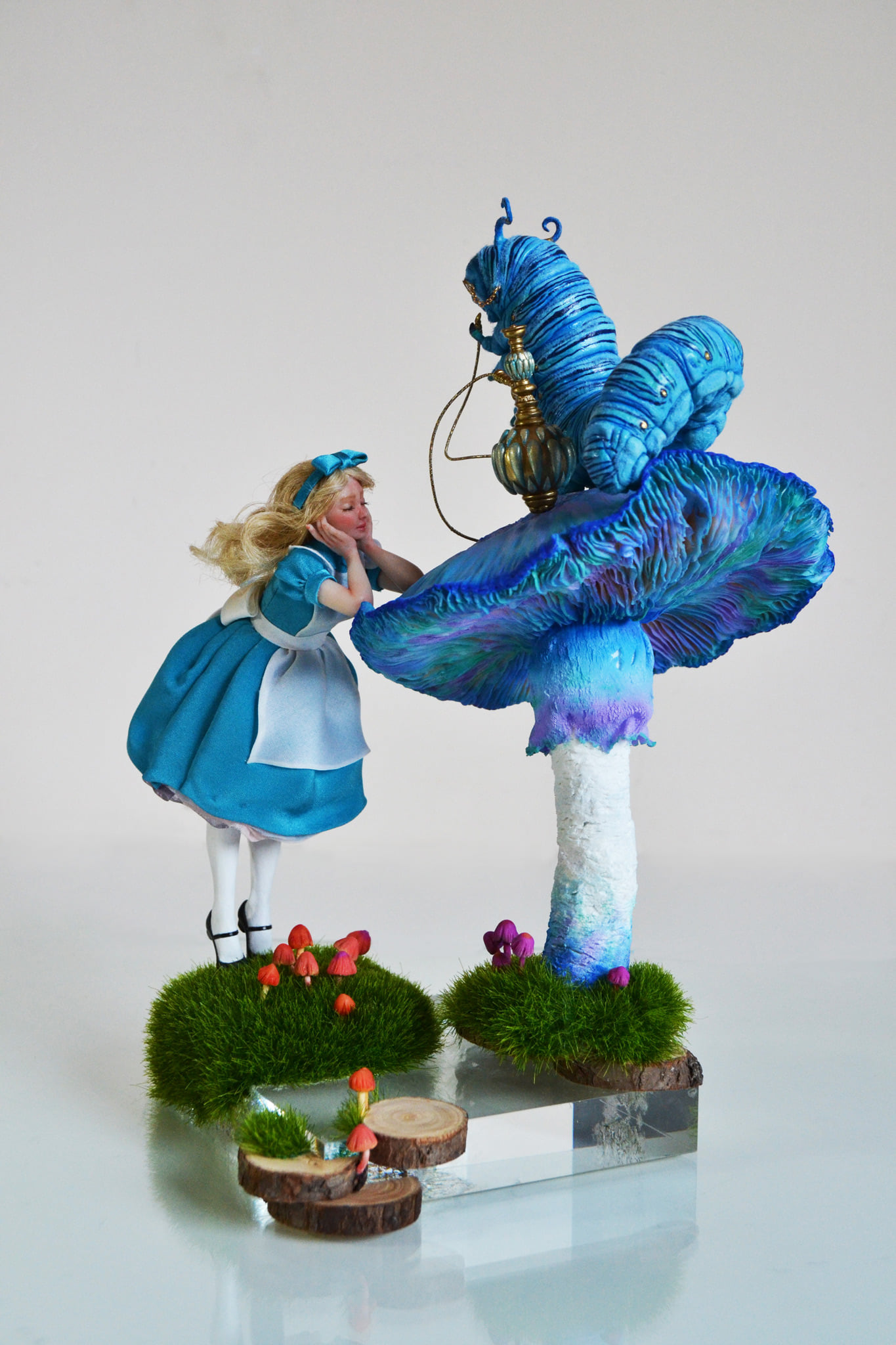
If you like underwater photography – and what landlubber doesn’t? – there’s an artist named Elena Kalis who specializes in just that. Her latest series is called “Alice in Waterland and Looking Glass,” and comprises of lovely submerged Alices. Her entire portfolio can be seen here.
The superbly rendered, playful black and white illustrations of Gennady Kalinovskii have up to now only been available in editions by Detskaya Literatura published in Moscow: Wonderland in 1977, retold and introduced by Boris Zakhoder, and Looking-Glass in 1980, retold and introduced by Vladimir Orel. The publisher Studio “4+4” from Moscow has recently reprinted them in a larger art edition (21.5 cm x 32.5 cm vs. 17 cm x 22 cm), with paper board and cloth binding. They can be ordered (in English) directly from the editor, Elena Borisova, for $90 for both books, including postage, at lborisova@rambler.ru. The books can be mailed anywhere.
You can read about these editions of Wonderland and Looking-Glass on a Russian website; if your Russian is rusty, just click on the small image of the book at the bottom of the page and you can flip through it. Wonderland is ISBN 978-5-99-02284-8-1 and Looking-Glass is ISBN 978-5-9902284-5-0.
Move over Sgt Pepper’s Lonely Hearts Club Band. Discussing the Divine Comedy with Dante is a spectacular gigantic painting by the Chinese artists Dai Dudu, Li Tiezi, and Zhang An (2006, oil on canvas). The original is an impressive 20′ x 8.5′ (6m x 2.6m). If you go to this link, there is a very large high-quality image that lets you hover your mouse over faces to see who they are, with a Wikipedia link. Where’s Lewis Carroll?
Discussing the Divine Comedy with Dante - by Dai Dudu, Li Tiezi, and Zhang An (2006, oil on canvas)
Hint: Lewis Carroll is literally hiding. I love how Darwin and Noah seem to be the same person. Also, when you click on the camel, it takes you to a list of “celebrities that look like camels.” There’s a further discussion of some of the clever quirks of the painting here at Convivium. For instance, “Leonardo da Vinci worked for evil rulers such as Cesare Borgia and here he listens politely to Stalin’s mad schemes.”
Paleontologists and artists alike may be interested to hear of a new project to further our understanding of the unfortunate Raphus cucullatus, otherwise known as the dodo. Fewer that 300 years ago the bird was strutting around Mauritius, yet today only two complete skeletons are known to science. Researchers at the Massachusetts College of the Holy Cross are hoping to extend the influence of one of those skeletons by giving it new life online.
Cast of mummified dodo head (looking thoughtful) from Aves 3D
The skeleton has been scanned in 3D, digitized, and uploaded to a public website funded by the National Science Foundation. Using a Java plugin, users can manipulate 3D images of the individual bones, as well as a mummified head (left).
We first read about the story in Digging up the Dodo, an article on IOLscitech. The dodo images are found on Aves 3D. The Aves 3D database contains images of many bird species; it’s primary aim is “to allow for the rapid global dissemination of three-dimensional digital data on common as well as rare and potentially fragile species, in a format ready for a variety of quantitative and qualitative analyses, including geometric morphometric analysis and finite element analysis.”
After conducting our own research using the data, we can also report that by careful rotation of the mummified head image it is possible to produce quite convincing facial expressions including “solemn,” “offended,” and “thoughtful.” Each expression requires tiny adjustments to the image, but of course, as the most famous dodo of all once advised, “the best way to explain it is to do it.”
The Dormouse in Chapter VII of The Annotated Alice (pgs. 93-95) gets the following footnote from Martin Gardner:
The British dormouse is a tree-living rodent that resembles a small squirrel much more than it does a mouse. The name is from the Latin dormire, to sleep, and has reference to the animal’s habit of winter hibernation. Unlike the squirrel, the dormouse is nocturnal, so that even in May (the month of Alice’s adventure) it remains in a torpid state throughout the day. In Some Reminiscences of William Michael Rossetti, 1906, we are told that the dormouse may have been modeled after Dante Gabriel Rossetti’s pet wombat, which had a habit of sleeping on the table. Carroll knew all the Rossettis and occasionally visited them.
This is the second blog post in a series for the LCSNA called Gardner’s Annotations Hyperlinked, in which we employ the mighty power of the internet to illuminate, investigate, and of course provide links for the footnotes from The Annotated Alice.
The only dormouse native to the British Isles is the Hazel dormouse, which is indeed more closely related to a squirrel than to a mouse. (The suborder Sciuromorpha contains chipmunks, squirrels, and dormice. Mice and rats are muroids.) Although dormire in Latin does mean “to sleep,” it might not be directly related to the etymology of “dormouse.” The Wiktionary‘s etymology: “From Middle English dormous, of uncertain origin. Possibly from dor-, from Old Norse dár (‘benumbed’) + mous (‘mouse’). … Although the word has come to be associated as an Anglo-Norman derivative of Old French dormir(‘to sleep’), no such Anglo-Norman word is known to have existed,” and it cites the Random House Dictionary as its reference. (The dormousian association with sleepiness seems to go back centuries – the Elizabethans apparently rubbed dormouse fat on the soles of their feet to induce sleep, according to The Sleepyhead’s Bedside Companion by Sean Coughlan. How could an animal both nocturnal and hibernating have any other reputation? We posted a cute viral video of a snoring dormouse a few months ago here.)
William Michael Rossetti (1829-1919)
As for Gardner’s one literary reference in his note, the Pre-Raphaelite memoir Some Reminiscences of William Michael Rossetti (1906), it’s widely available and has been reprinted multiple times in the past decade. Google Books has several accessible copies of the text: Vol. I here; Vol. II here. It is true that C.L. Dodgson knew the Rossetti’s and would hang out with them sometimes. It is also true that Dante Gabriel Rossetti owned several wombats (and some dormice and other exotic pets), and that one beloved wombat would entertain at dinner parties. However, it’s impossible that Gardner read in that specific book that Rossetti’s wombat “may have” inspired Carroll’s dormouse, because it’s neither written there nor true. In Volume I of Some Reminiscences, William Michael Rossetti describes some of the “beasts” Dante Gabriel kept in his garden, after which he describes his indoor pets:
From "Rossetti and his Circle" by Max Beerbohm. One of those animals is supposed to be a wombat.
…they were my brother’s companions day by day, and the wombat would follow at the housemaid’s heels when she went upstairs to make the beds. An anecdote is current of the wombat, and I accept it as only somewhat exaggerated – not untrue. My brother had asked, as he pretty often did, several friends to dinner; he himself never smoked, but for the satisfaction of his guests he had provided a box of superior cigars. The dinner over, he proceeded to produce the box. The box was there, but the cigars were gone: the wombat had made a meal of the entire assortment.
The Rossetti Family, photographed by Lewis Carroll (1863)
Hilarious! The wombat ate some fancy cigars. Sounds like a good party (except for the shortage of tobacco). He then goes on to describe several drawings of wombats by Edward Burne-Jones he owned, and of poetry by Christina Rossetti which mentions wombats as well. (“When wombats do inspire / I strike my disused lyre.”) Carroll is not mentioned in Volume I. Neither is any dormouse nor any of the Alice books ever mentioned in either volume of Some Reminiscences. In Volume II, William Michael Rossetti has one uninspiring paragraph about Carroll:
Lewis Carroll's photograph of Dante Gabriel Rossetti (1863)
One of the earliest of these [visiting authors] but I only saw him once or twice was the Rev. C. L. Dodgson, whom the English-speaking world knows under the name of Lewis Carroll. He was a skilful amateur photographer, and he took some few photographs of Dante Rossetti, and of other members of the family. He continued keeping up some little acquaintance with Christina till the close of her life, sending her his successive publications. My reminiscence of Mr. Dodgson is so slight and indeterminate that it would be vain to attempt any exactness of description. Suffice it to say that he impressed me mainly as belonging to the type of ” the University Man ” : a certain externalism of polite propriety, verging towards the conventional. I do not think he said in my presence anything ” funny ” or quaint.
The only mention of wombats in Volume II is a reference to his unsuccessful attempt to purchase one in Sydney.
So where did Martin Gardner learn that Rossetti’s wombat inspired Carroll’s Dormouse? I don’t know, but he didn’t invent the idea. That honor goes to the Pre-Raphaelite painter Ford Madox Brown. The artist’s grandson, Ford M. Hueffer (who changed his name to Ford Madox Fordand became a 20th Century novelist) wrote the book on Madox Brown in 1896: Ford Madox Brown: a record of his life and work. He also describes the Rossetti zoo and some legendary parties:
The beast that made the greatest impression, at least on Madox Brown, was the singularly inactive marsupial known as the wombat – an animal that seems to have exercised a latent fascination on the Rossettian mind. On high days and holiday banquets it occupied a place of honour on the épergne in the centre of the table, where, with imperturbable equanimity, it would remain dormant. On one occasion, however, it belied its character. Descending unobserved, during a heated post-prandial discussion, it proceeded in leisurely fashion to devour the entire contents of a valuable box of cigars, achieving that feat just in time for the exhaustion of the subject under consideration and consequent attention to things mundane.
If Madox Brown may be believed, the wombat of Rossetti was the prototype of the dormouse in ‘Alice in Wonderland,’ the author of which beloved work was a frequent visitor of Rossetti’s household at Chelsea. The ‘ Alice ‘ books exercised an even greater fascination over Rossetti and for that matter over Madox Brown than the historic wombat had done …
Note Ford’s subtle skepticism of his grandfather’s word. I found the final nail in the coffin to the Wombat-Dormouse theory in a 2003 lecture by Angus Trumble, the Harold White Fellow at the National Library of Australia, Canberra. Trumble adds some Australian local knowledge to his scholarship, in a talk called “Rossetti’s Wombat: A Pre-Raphaelite Obsession in Victorian England.”
A crystal épergne ($160) from the Horchow Collection, 20"H x 17"W x 14 1/4"D. Adult wombats are approx. 39" long.
…James McNeill Whistler invented a silly story about how the wombat had perished after eating an entire box of cigars. Ford Madox Brown thought that Rossetti’s habit of bringing the wombat to dinner and letting it sleep in the large épergne or centrepiece on the dining room table inspired the dormouse in the tea-pot incident at the Mad Hatter’s Tea Party in Alice’s Adventures in Wonderland. This is also impossible because Lewis Carroll wrote that chapter in 1863, and the novel with its famous illustrations by John Tenniel was published two years later in 1865. As my colleague David Marshall has also pointed out, either Rossetti’s épergne was enormous, or the wombat was dramatically small.
He says “impossible,” because his research shows that Dante Rossetti had bought the first of his pet wombats in 1869. I don’t know how big an épergne usually is, but dormice certainly fit more easily into teapots than wombats do. Do wombats fit in teapots? Do teapots fit in wombats?
"Dormouse surnamed Dwanging," by Dante Gabriel Rossetti, c. 1834 (age 6), pencil on paper.
Several final discoveries about cute animals owned by Pre-Raphaelites before we go. One of the earliest drawings by Dante Gabriel Rossetti was of a dormouse – he drew pictures of his pet dormouse named “Dwanging” when he was about six years old. It looks to me more like a cave painting than anything drawn by any pre-tween I know. In Dante Gabriel Rossetti: his family-letters, Vol. I, his brother also describes his pet hedgehog, which also hung out on the family dinner table. So Dante was into pets long before he acquired his own large collection of strange creatures as an adult. What became of the wombat? It died.
"I never reared a young Wombat / To glad me with his pin-hole eye, / But when he most was sweet & fat / And tail-less; he was sure to die!" Dante Gabriel Rossetti, 1869
"May I please sit on your épergne?"
American artist James McNeill Whistler’s version of the story (from this early biography) has the wombat skeleton discovered in the cigar box. (A humongous cigar box?) I wouldn’t attempt to guess how Rossetti’s wombat actually died, but eating tobacco is extremely poisonous. According to the Wikipedia, “The LD50of nicotine is 50 mg/kg for rats and 3 mg/kg for mice. 0.5-1.0 mg/kg can be a lethal dosage for adult humans, and 10 mg (0.1mg/kg) for children.” A cigar contains around 150 mg of nicotine. Wombats weigh between 20 and 35 kg. Eating even a single cigar would very likely kill a wombat. Again, I’m not trying to perpetuate the theory that Rossetti’s wombat died from eating cigars at the dinner party in question. But either William Michael Rossetti’s anecdote is more than “only somewhat exaggerated,” or it didn’t end well for the wombat.
The artist uses creative mark-making and layering to craft the dreamlike illustrations. In Kodomos’ world the White Rabbit is monstrously large, and shadowy landscapes reveal an even more surreal and nightmarish side of the fantasy story. These images are really special!
They actually reminded me, in a spooky way, of Barry Moser’s Dante illustrations. There seems to be only about five, plus some close-ups on the Cheshire Cat, but we’d love to see more.
John Tenniel's illustration of "Pig and Pepper," from Alice's Adventures in Wonderland (1865) by Lewis Carroll
When we first meet the Duchess in Chapter VI of The Annotated Alice, Martin Gardner’s footnote (on page 82) is this:
A glance at the portrait of the Ugly Duchess, by the sixteenth-century Flemish painter Quintin Matsys (it is reproduced in Langford Reed’s book on Carroll) leaves little doubt that it served as the model for Tenniel’s duchess. Matsys’s duchess is popularly supposed to be Margaretha Maultasch, a fourteenth-century duchess of Carinthia and Tyrol. “Maultasch,” meaning “pocket-mouth,” was a name given to her because of the shape of her mouth. The unhappy life of poor Margaret, who had the reputation of being the ugliest woman in history, is told by Lion Feuchtwanger in his novel The Ugly Duchess. (See “A Portrait of the Ugliest Princess in History,” by W. A. Baillie-Grohman, Burlington Magazine, April 1921).
Classic Gardner, in that is fascinating, imformative, but slightly dated, as it references a bunch of books and articles that are difficult to find in the 21st Century. The Life of Lewis Carroll by Langford Reed was published in 1932, and rarely or never afterwards. A few used copies turn up on Amazon for as cheap as $19.50. (The picture to the left is from an eBay copy listed for $14.99. A scanned copy is on Google Books, but the full text is currently restricted.) If one wanted to see Matsys’ painting, and can’t make it today to the National Gallery in London where it hangs, it’s still a quasi-famous if not iconic image and there are copies all over the internet. Recent research about the painting, as reported by the Guardian in 2008, solved a few old mysteries: “firstly, the portrait is truthful and she almost certainly looked like that, and secondly, a long held historical theory that the painter was copying Leonardo da Vinci is wrong. The medical research shows that she was suffering from an advanced form of Paget’s disease – osteitis deformans – which enlarged her jaw bones, extended her upper lip and pushed up her nose. It also affected her hands, eye sockets, forehead, chin and collarbones.” Gardner says there is “little doubt” that the Matsys image inspired Tenniel, and I presume he can state that without a reference because the portrait was famous enough, and his illustration evocative of it enough, to be obvious. (The nose, the headdress, the “pocket-mouth.”)
"An Old Woman ('The Ugly Duchess')" by Quintin Matsys, c. 1515, Oil on Oak, 25.6" by 17.9"
The Google Art Project has a very high quality image of the painting here. You can zoom in close and see every crack in her décolletage. (If you’re unfamiliar with the Google Art Project, it lets you wander around famous museums all over the world, virtually wander from room to room, and then study paintings in spectacular detail.)
Lion Feuchtwanger utilized her story in his novel The Ugly Duchess and in 1816 Jacob Grimm collected the ‘Legends of Margarete’ in his book German sagas.” Did you catch that? The original Margaret may actually have been “beautiful,” and it was centuries of folklore that created the figure of the Ugly Duchess. And then centuries later, people began to associate her with the painting of “An Old Woman.”
As for Feuchtwanger’s 1923 historical novel, Die häßliche Herzogin Margarete Maultasch (The Ugly Duchess), also recommended in Gardner’s footnote, it also appears to be out of print. First Editions in German go on Amazon for over a hundred dollars, but used copies of later editions can be found for $11. Used copies of Willa Muir and Edwin Muir’s translation into English, also out of print, can be found for pretty cheap. The text for the Feuchtwanger is also on Google Books in German and English, but it’s also currently restricted.
But just as we were beginning to get discouraged that none of the books Gardner referenced could still be found easily, Whala! ”A Portrait of the Ugliest Princess in History,” by W. A. Baillie-Grohman, in Burlington Magazine’s April 1921 issue, can be found on the Internet Archive here! Thank you, Brewster Kahle.
Vol. xxxviii, p. 31 (Jan., 1021).
A PORTRAIT OF THE UGLIEST PRINCESS IN HISTORY
BY W. A. BAILLIE-GROHMAN
HE accompanying plate [a] is from
the portrait of Duchess Margaret of
Tyrol, better known as Pocket-
mouthed Meg, by the hand of Ouen-
tin Matsvs. [continue reading...]
(‘Y’s sometimes look like ‘v’s when text is scanned in, et cetera.) Subscribers to the Burlington Magazine can still read back issues online, but I’m not sure if that goes all the way back to 1921. (If the quote from the Internet Archive above can be believed, the article might be from January 1921, not April.)
This is the first blog post in a series I call “G.A.H.! (Gardner’s Annotations Hyperlinked),” named after the exclamation (“GAH!”) we sometimes speak softly when a footnote references a book that is increasingly difficult to put your greasy paws onto. The Annotated Alice is still the definitive edition of Lewis Carroll’s masterpiece, but sometimes it needs some links.
[Department of Portmanteaus] Today we give an honorable mention to the Brooklyn-based design studio Snarkitecture, recently featured in the Home & Garden section of the New York Times online. The studio, headed by Alex Mustonen and Daniel Arsham, creates sculptures and installations intended to unsettle: “Searching for sites within architecture with the possibility for confusion or misuse, Snarkitecture aims to make architecture perform the unexpected.” An exhibition of “funiture” — furniture that counts furnishing least among its aspirations, is currently on display at the Volume Gallery in Chicago.
Before there was Instagram, people used chemical emulsifying processes to make their photographs look cool. An American artist named Mabel Odessey will have a site-specific installation at France’s Château de Lacaze from May 6 thru 30th, using the distinctly retro technique of pinhole photography. She described the show to us in an e-mail:
The photographs are made from marionettes made in the 1940s based on Tenniel illustrations. The installation will use different parts of the château to consider different aspects of the the Alice books. Visitors will descend (like Alice through the rabbit hole) into a cave like area where the photographs will pose questions of identity and perception. Visitors will then climb up to the mezzanine areas and consider the philosophical, and nonsense aspects of the books, another passageway will lead to the domain of the Queen of hearts and Carroll’s satirical look at Victorian society.
Lacaze is in the Southeast Tarn department of France. Mabel Odessey has many more galleries of her pinhole photography at her website www.mabelodessey.com. An article by Odessey and pictures from the installation will be featured in the Spring 2012 Knight Letter number 88, available to LCSNA members.
In Russia, a forty-year-old professional photographer named Vladimir Clavijo-Telepnev has also been creating beautiful old-fashion images of Alice. His series called Alice in Wonderland can be seen at his website here. There’s also a nice YouTube montage:
Japanese artist Yayoi Kusama is a living legend. Born in 1923, she spent much of the 60s and 70s in New York’s avant garde art scene whipping up a multi-media storm of iconic sculptures, open air installations, anti-war protests and controversy. Since 1977 she has been a voluntary resident at a psychiatric facility in Japan, but she has never stopped creating art. This spring England’s leading institute for modern art, the Tate Modern, is holding a retrospective of her work.
Now, aged 83, she has turned her considerable talents to illustrating Alice’s Adventures in Wonderland. The cloth-bound volume was published by Penguin Classics last month and is available from Amazon. The promotional video below gives a tantalizing tour of her marvelous illustrations. The title of this blog post is taken from the first page of the book.